
Dental Bridges in Tirana, Albania
Replace one or more missing teeth with a fixed, non-removable ceramic bridge — faster than implants, more affordable than multiple restorations, and completed in a single trip to Tirana.
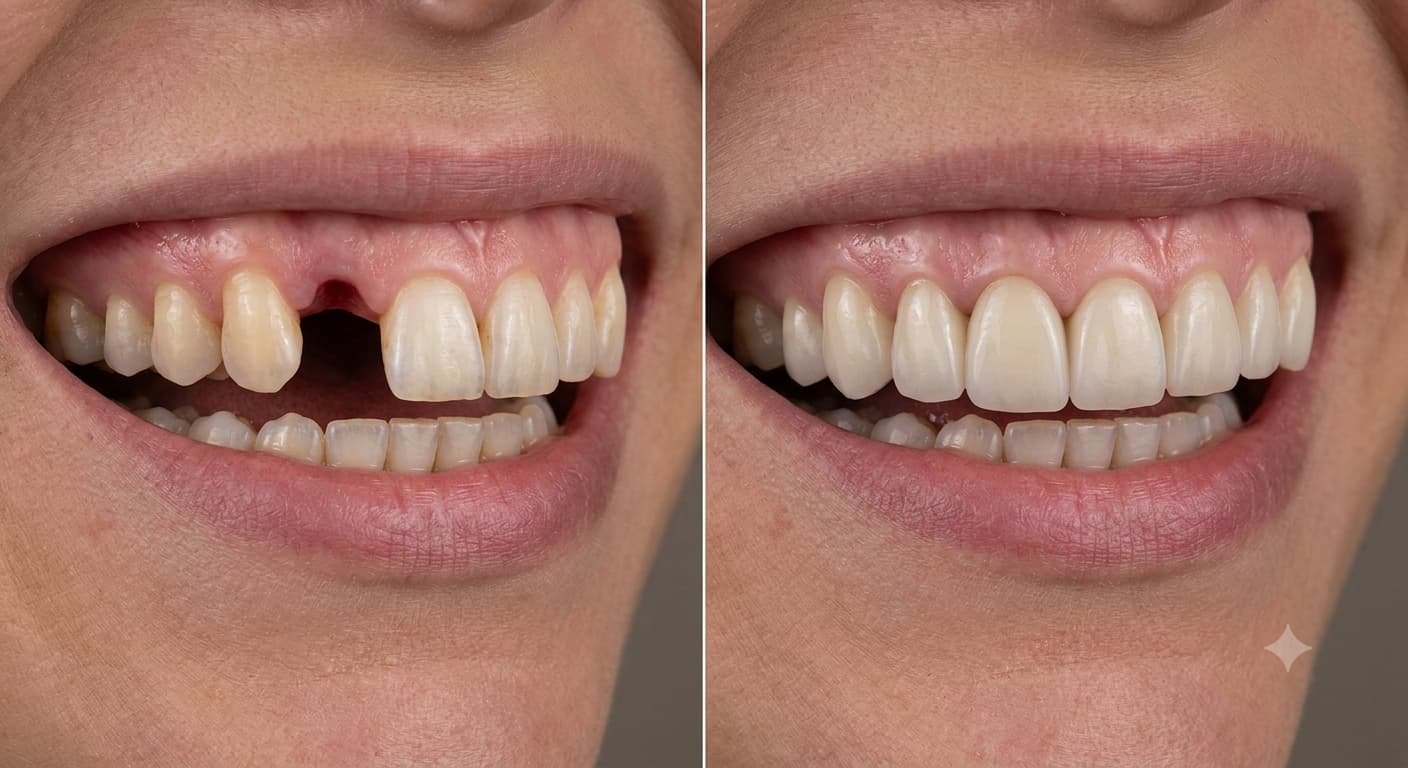
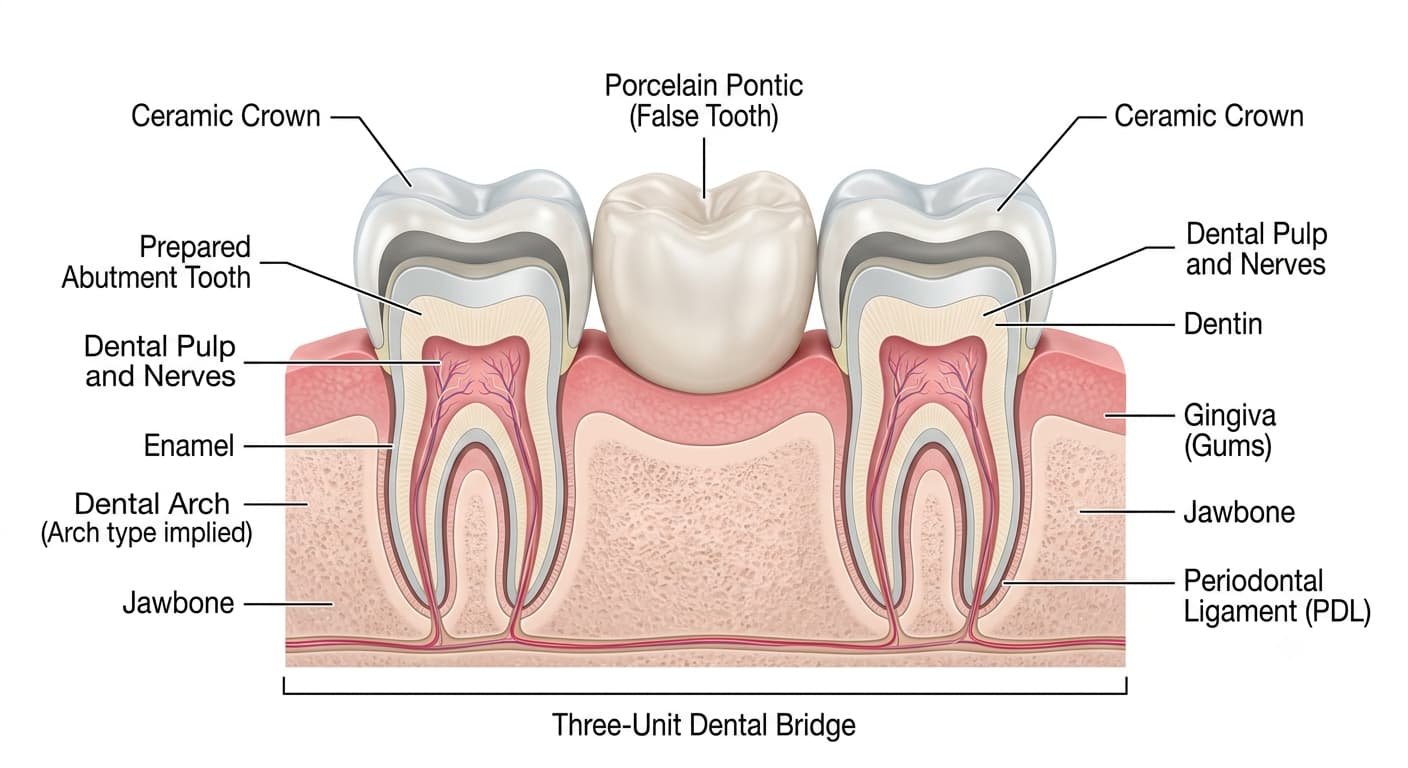
What is a dental bridge?
A dental bridge is a fixed prosthetic restoration that replaces one or more missing teeth by anchoring to the natural teeth or implants on either side of the gap. The anchor teeth — called abutments — are prepared and crowned, and a false tooth (the pontic) is suspended between them, "bridging" the space.
Unlike removable dentures, a bridge is permanently cemented and cannot be taken out. Unlike an implant, it does not require surgery and is completed faster — making it the preferred solution for patients who need a faster result, cannot have surgery, or where the adjacent teeth already require crowning.
- Fixed — permanently cemented, not removable
- No surgery required — no implant, no bone work
- Completed in a single trip of 5 days
- Ideal when adjacent teeth already need crowning
- E-max, Zirconia, or PFM — material chosen for your case
- Fabricated in our in-house laboratory — same trip
Which bridge is right for your situation?
Not all bridges use the same design. The type recommended depends on the location of the missing tooth, the condition of the adjacent teeth, and the number of teeth being replaced. We discuss all options transparently at your consultation.
Traditional 3-Unit Bridge
One missing tooth replaced by crowning both adjacent teeth and connecting a pontic between them. The most widely used bridge design — strong, well-established, and suitable for any position in the mouth.
- 2 abutment crowns + 1 pontic
- Both adjacent teeth are prepared and crowned
- Suitable for front and back teeth
- E-max (front) or Zirconia (back) recommended
- Lifespan: 10–15 years with proper care
Maryland Resin-Bonded Bridge
A pontic supported by metal or ceramic wings bonded to the back surfaces of adjacent teeth — without crowning them. A minimal-preparation option for front teeth where preserving tooth structure is a priority.
- Minimal preparation — adjacent teeth not crowned
- Wings bonded to the lingual surface
- Best for: front teeth, young patients
- Lower strength than traditional bridge
- Lifespan: 5–10 years
Implant-Supported Bridge
When multiple adjacent teeth are missing, two implants can support a bridge of 3 or more units — replacing several teeth without crowning natural teeth. Combines implant stability with bridge efficiency.
- No natural teeth used as abutments
- 2 implants support 3–4 unit bridge
- Best for: 2–3 adjacent missing teeth
- More cost-effective than individual implants
- Lifespan: 15+ years
Bridge materials — E-max, Zirconia, and PFM
The same material options available for individual crowns apply to bridges. Material selection depends on the position in the mouth, biting forces, and aesthetic requirements.
E-max (Lithium Disilicate)
The most aesthetic ceramic bridge material. Natural light transmission mimics real enamel — ideal for visible anterior teeth where a natural appearance is the priority. Excellent for 3-unit bridges in the front of the mouth.
Full Zirconia
Maximum strength for posterior bridges that bear heavy biting forces. High-translucency zirconia also delivers excellent aesthetics — the preferred material for molar bridges, bruxism patients, and implant-supported bridges.
PFM (Porcelain-Fused-to-Metal)
A metal framework with a porcelain outer layer. The traditional bridge material — strong, durable, and the most affordable option. The metal margin may become visible at the gum line over time, making PFM less suitable for highly visible front teeth.
Which is the right solution for you?
The most common question when a tooth is missing: bridge or implant? Both are valid solutions — the right choice depends on clinical factors, timeline, and budget. We present both options honestly at every consultation.
| Factor | Dental Bridge | Single Implant |
|---|---|---|
| Surgery required | No | Yes — implant placement |
| Adjacent teeth affected | Yes — 2 teeth crowned | No — independent |
| Bone preservation | No — bone resorbs beneath pontic | Yes — stimulates bone |
| Treatment time | 5 days — one trip | 6–12 weeks total, 2 trips |
| Lifespan | 10–15 years | Lifetime (fixture) |
| Cleaning | Floss threader needed under bridge | Normal brushing & flossing |
| Best when… | Adjacent teeth need crowning anyway, faster timeline needed | Adjacent teeth are healthy, long-term investment preferred |
| Kocaqi price | From €390 (3-unit) | From €399 (implant + crown) |
Who is a dental bridge right for?
A bridge is suitable for most adults missing one to three adjacent teeth with healthy supporting teeth on either side. A clinical assessment confirms suitability, bone levels, and the condition of the abutment teeth.
Good candidates — bridge works well if you have…
- One to three adjacent missing teeth
- Healthy or restorable teeth on both sides of the gap
- Sufficient bone under the missing tooth for gum aesthetics
- Adjacent teeth that already need crowning
- A need for faster treatment — single trip preferred
- Medical reasons that make implant surgery unsuitable
- Good oral hygiene habits — bridges require careful cleaning
Consider alternatives if you have…
- Completely healthy adjacent teeth — implant preserves them
- More than 3 adjacent missing teeth — All-on-4 or All-on-6 more appropriate
- Active gum disease or significant bone loss — must be treated first
- Heavily bruxing patients with existing failed bridges
- Young patients — implant preferred once jaw growth is complete
The dental bridge procedure — completed in one trip
From consultation to permanent cementation in 5 days. Here is exactly what happens at each stage of your bridge treatment at Kocaqi Dental.
Online Consultation & X-Ray Review
Send us photographs of the gap and any existing X-rays of the area. We assess the condition of the adjacent abutment teeth, bone levels beneath the gap, and the span of the bridge needed. A fully itemised written quote — including the number of units and material recommendation — is provided within 24 to 48 hours. If additional preparatory work such as a root canal on an abutment tooth is needed, this is identified and included in the quote.
Clinical Assessment & Preparation Planning
Full clinical examination, periapical X-rays of the abutment teeth, and gum health assessment. The final treatment plan is confirmed — material, span, and preparation design. Any required pre-bridge treatment (root canal, build-up) is completed at this appointment before preparation begins.
Abutment Preparation & Temporary Bridge
Under local anaesthesia, both abutment teeth are shaped to create the clearance needed for the bridge material. A digital intraoral scan captures the prepared teeth and the opposing bite with precision. A well-fitting temporary bridge is cemented the same day — you leave with full aesthetic and functional coverage while the permanent bridge is fabricated.
In-House Bridge Fabrication
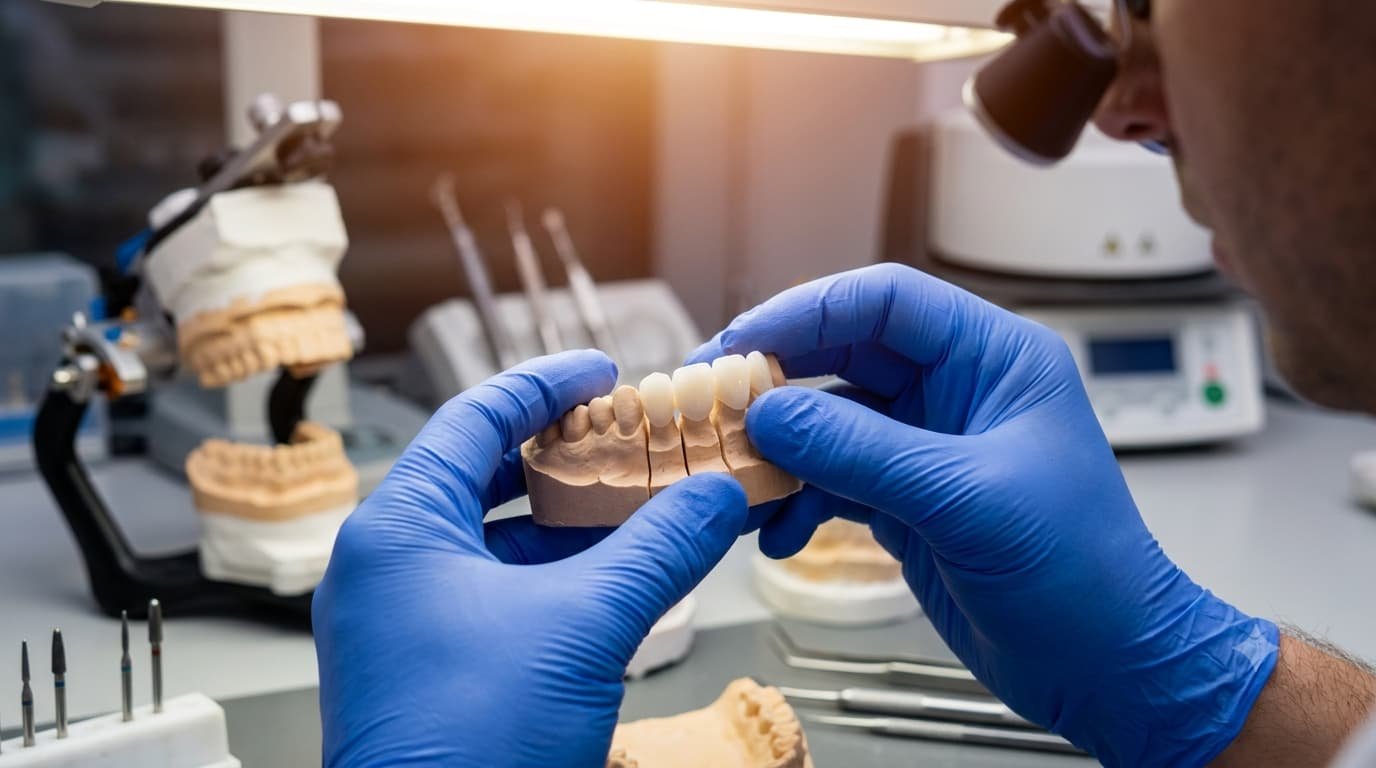
Your bridge is fabricated in our on-site laboratory from the digital scan data. The dentist and technician collaborate directly on shade, contour, and contact points — eliminating the delays and communication gaps of external lab outsourcing. You are free to explore Tirana during fabrication.
Bridge Fitting & Permanent Cementation
The permanent bridge is tried in dry first — fit, contacts, shade, and aesthetics are all checked and approved before any cement is used. Once confirmed, the bridge is permanently cemented on both abutments. Bite and margins are refined and polished. You leave with a fully finished, permanent, guaranteed restoration.
Dental Bridge Cost in Albania
Bridge pricing is per unit — each crown in the bridge (including the pontic) is priced individually. A standard 3-unit bridge = 2 abutment crowns + 1 pontic. All prices include preparation, temporary bridge, in-house fabrication, cementation, and follow-up.
| Bridge Type | Kocaqi — Tirana | Western Europe avg. | Saving |
|---|---|---|---|
| 3-Unit Zirconia Bridge (most common) | from €390 | €1,200 – €2,500 | ~75% |
| 3-Unit E-max Bridge (front teeth) | from €450 | €1,500 – €2,800 | ~75% |
| 3-Unit PFM Bridge | from €300 | €900 – €1,800 | ~75% |
| 4-Unit Bridge (2 missing teeth) | from €520 | €1,600 – €3,200 | ~75% |
| Implant-Supported Bridge (3-unit on 2 implants) | Get a quote | €3,000 – €5,500 | ~70% |
Prices are per bridge unit (crown or pontic). Any pre-bridge treatment — root canal, post, build-up — is quoted and confirmed separately before treatment begins. All costs in writing before any work starts. No hidden fees.
Why patients choose Kocaqi for dental bridges
In-House Laboratory
Your bridge is fabricated on-site by our dedicated dental technician. Direct dentist-technician communication on shade, contour, and fit means the bridge delivered on day 5 is exactly what was planned on day 2 — with no external lab delays or communication gaps.
Digital Intraoral Scanning
Impressions taken digitally — no tray, no impression material, no gagging. Digital scans capture the prepared abutments and opposing bite with sub-millimetre accuracy, producing a bridge with a precise marginal fit that minimises the risk of recurrent decay.
10-Year Written Guarantee
All bridges placed at Kocaqi Dental carry a 10-year written guarantee against material failure and cementation defects. Documented in your patient record and valid regardless of where you live.
Honest Bridge vs Implant Advice
We present both options transparently — their clinical advantages, limitations, and costs. If an implant is the better long-term choice for your situation, we say so. If a bridge is more appropriate, we explain why. You make an informed decision, not one driven by our revenue.
Completed in 5 Days
Preparation to permanent cementation in a single 5-day visit. Patients travelling from the UK, Germany, or Italy typically arrive Sunday, complete their bridge, and return home by Friday. No second trip required.
Full Treatment Coordination
If an abutment tooth requires a root canal before bridging, or a build-up after a large filling, all preparatory work is completed in-house by the same team — no referrals, no separate providers, no record gaps.
Dental bridges — your questions answered
How long does a dental bridge last?
Zirconia and E-max bridges typically last 15 years or more with proper oral hygiene and regular dental check-ups. PFM bridges average 10 to 15 years. The primary factors affecting longevity are oral hygiene around the bridge margins, the health of the abutment teeth, and biting habits. All bridges at Kocaqi Dental carry a 10-year written guarantee.
Is getting a bridge painful?
The preparation appointment is performed under local anaesthesia and is essentially painless. Some sensitivity on the prepared abutment teeth while the temporary bridge is in place is normal — particularly to cold — and resolves once the permanent bridge is cemented. If either abutment tooth has had a root canal, there is no nerve remaining and no sensitivity at all.
Can I eat normally with a dental bridge?
Yes — once permanently cemented, a well-made bridge functions like natural teeth. There are no specific dietary restrictions. We advise avoiding using the bridge to bite into very hard objects (ice, hard nuts, opening packaging) as this applies point pressure that can fracture any ceramic restoration over time.
How do I clean under a dental bridge?
The pontic (false tooth) is suspended above the gum — you cannot floss normally through this area. A floss threader or interdental brush is used to pass under the bridge and clean the gum surface beneath the pontic. This takes an extra minute per day and is important for long-term gum health beneath the bridge. Our team demonstrates the technique and provides the tools at your cementation appointment.
Should I get a bridge or an implant?
If the adjacent teeth are completely healthy — an implant is generally the better long-term choice: it preserves bone, leaves neighbouring teeth untouched, and lasts longer. A bridge is preferable when the adjacent teeth already need crowning anyway, when a faster single-trip solution is needed, or when implant surgery is not possible. We discuss both options honestly at every consultation — including the cases where we recommend the less expensive option.
Can a bridge be replaced with an implant later?
Yes — if a bridge fails at some point in the future and the adjacent abutment teeth are still present, a new bridge can be placed. Alternatively, if adequate bone is still present, an implant can replace the missing tooth independently and the abutment crowns can be made as standalone crowns rather than abutments. The option to transition from a bridge to an implant remains open.
A fixed bridge fitted in 5 days — with a 10-year guarantee
Send us photos and X-rays of the missing tooth area. We'll assess the abutment teeth, recommend the right bridge type and material, and provide a fully itemised written quote within 24 to 48 hours — free and with no obligation.
3-unit Zirconia from €390 · E-max · PFM · In-house lab · 10-year guarantee · 5 days · Save 75%