
Inlays & Onlays in Tirana, Albania
When a filling is not enough and a full crown would remove too much healthy tooth — an inlay or onlay is the perfect middle ground. A custom-made ceramic restoration that preserves maximum tooth structure while restoring full strength, function, and natural aesthetics.
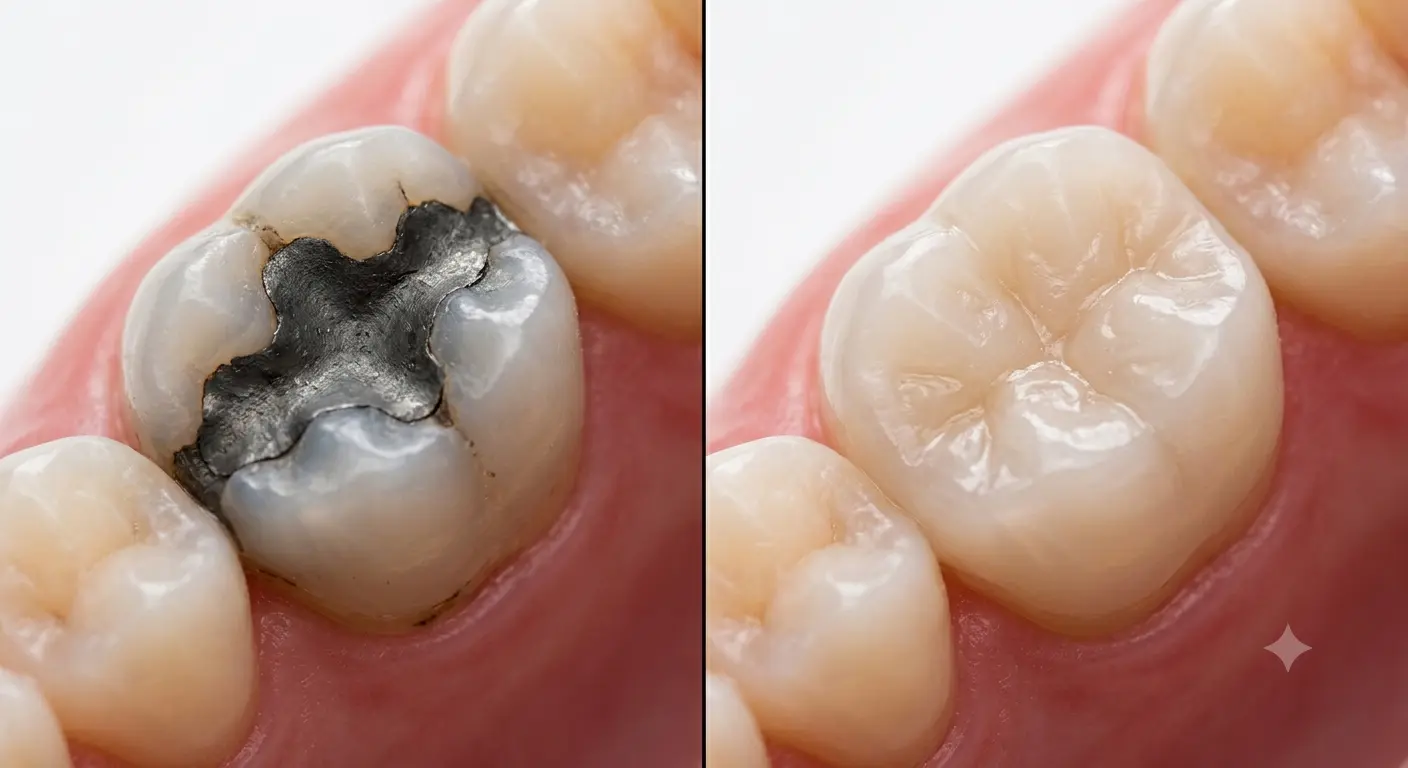
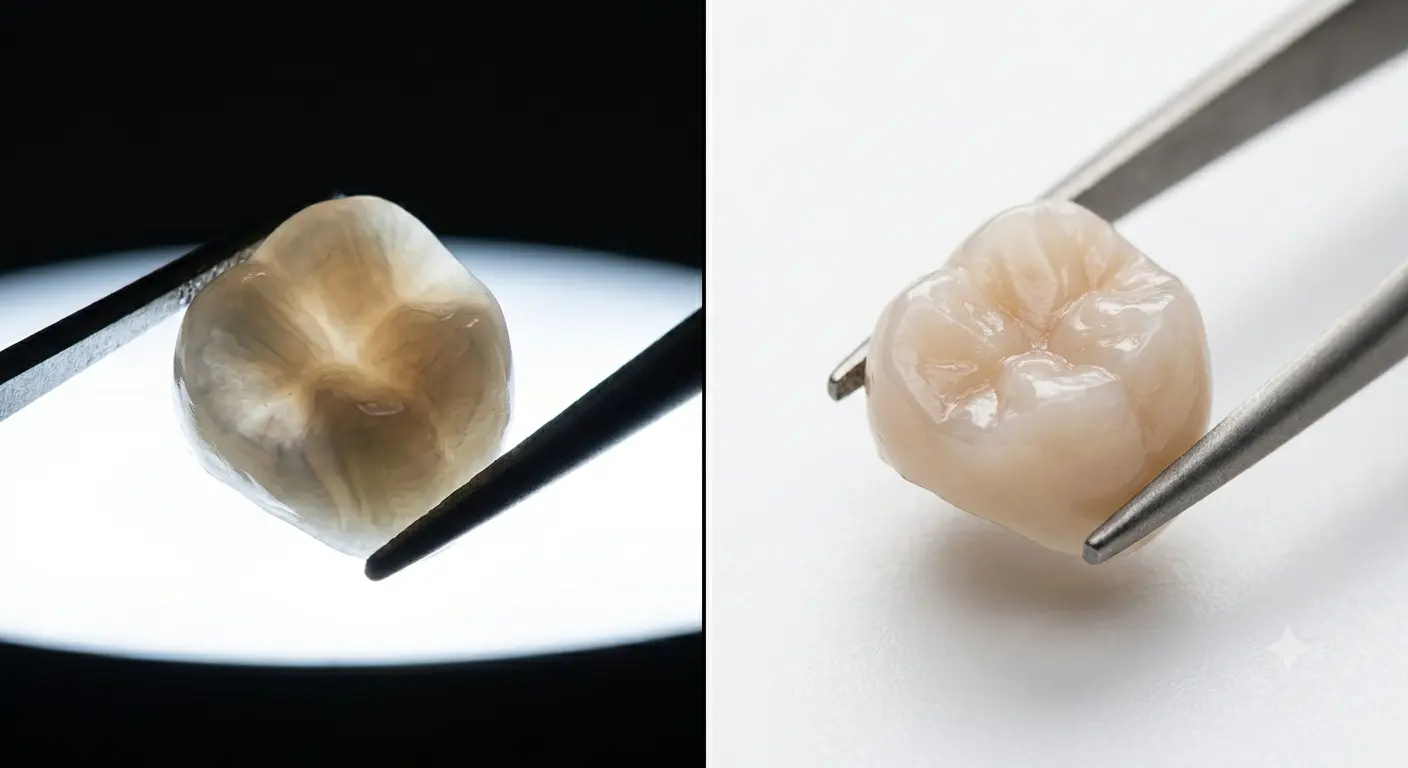
What are inlays and onlays?
Inlays and onlays are custom-made ceramic or composite restorations that fit precisely into or over the chewing surface of a damaged or decayed back tooth. They occupy the middle ground between a filling (which fills a cavity from within) and a crown (which covers the entire tooth) — restoring the tooth with minimal removal of healthy structure.
An inlay sits within the cusps of the tooth, restoring the central chewing surface. An onlay — sometimes called a partial crown — extends over one or more of the outer cusps, providing greater coverage and structural reinforcement when the damage is more extensive. Both are fabricated outside the mouth and cemented precisely into place, creating a stronger and more durable restoration than a direct filling of equivalent size.
- Removes far less healthy tooth than a crown
- Stronger than a direct filling of equivalent size
- E-max ceramic — matches natural tooth colour and translucency
- Fabricated in our in-house laboratory — precise fit
- Lasts 15 years or more with proper care
- Completed in a single trip of 5 days
Filling vs Inlay/Onlay vs Crown
The decision between a filling, an inlay or onlay, and a crown depends on how much of the tooth remains, the size and location of the damage, and the biting forces involved.
| Factor | Filling | Inlay / Onlay | Full Crown |
|---|---|---|---|
| Tooth structure removed | Minimal | Low — cusp-preserving | Significant — all surfaces |
| Suitable cavity size | Small to medium | Medium to large | Large / structurally compromised |
| Strength under biting load | Good for small cavities | Excellent — ceramic is rigid | Maximum — full coverage |
| Aesthetics | Good (composite) | Excellent — E-max ceramic | Excellent |
| Lifespan | 5–10 years (large fillings) | 15+ years | 15+ years |
| Kocaqi price | From €50 | From €150 | From €180 |
Three material options
The material chosen for your inlay or onlay affects its appearance, strength, and longevity. We discuss all options during your consultation.
E-max (Lithium Disilicate)
The preferred material for ceramic inlays and onlays. Exceptional aesthetics — light transmission matches natural enamel. Flexural strength of ~400 MPa provides excellent durability for premolars and molars. The gold standard for tooth-coloured posterior restorations.
Zirconia
Preferred for patients with bruxism or very heavy biting forces where maximum fracture resistance is the priority. Slightly less translucent than E-max but equally aesthetic in most molar cases. Flexural strength of 900–1200 MPa.
Composite Resin
Composite inlays can be placed chairside in a single appointment — no laboratory stage required. Less durable than ceramic over time but a valid option for smaller restorations or budget-conscious cases where ceramic's longevity advantage is less significant.
The inlay/onlay procedure
Completed in 5 days during a single trip. Two appointments — preparation and cementation.
Assessment & Treatment Planning
Clinical examination and X-rays confirm the extent of decay or damage and determine whether an inlay or onlay is the most appropriate restoration. The decision between inlay, onlay, and crown is explained with clear clinical reasoning.
Tooth Preparation & Digital Scan
Under local anaesthesia, decay and damaged tooth structure are removed and the cavity is shaped with smooth, defined margins that allow precise fit of the restoration. A digital intraoral scan captures the prepared tooth with sub-millimetre accuracy. A temporary restoration is placed the same day to protect the tooth while the inlay is fabricated.
In-House Fabrication
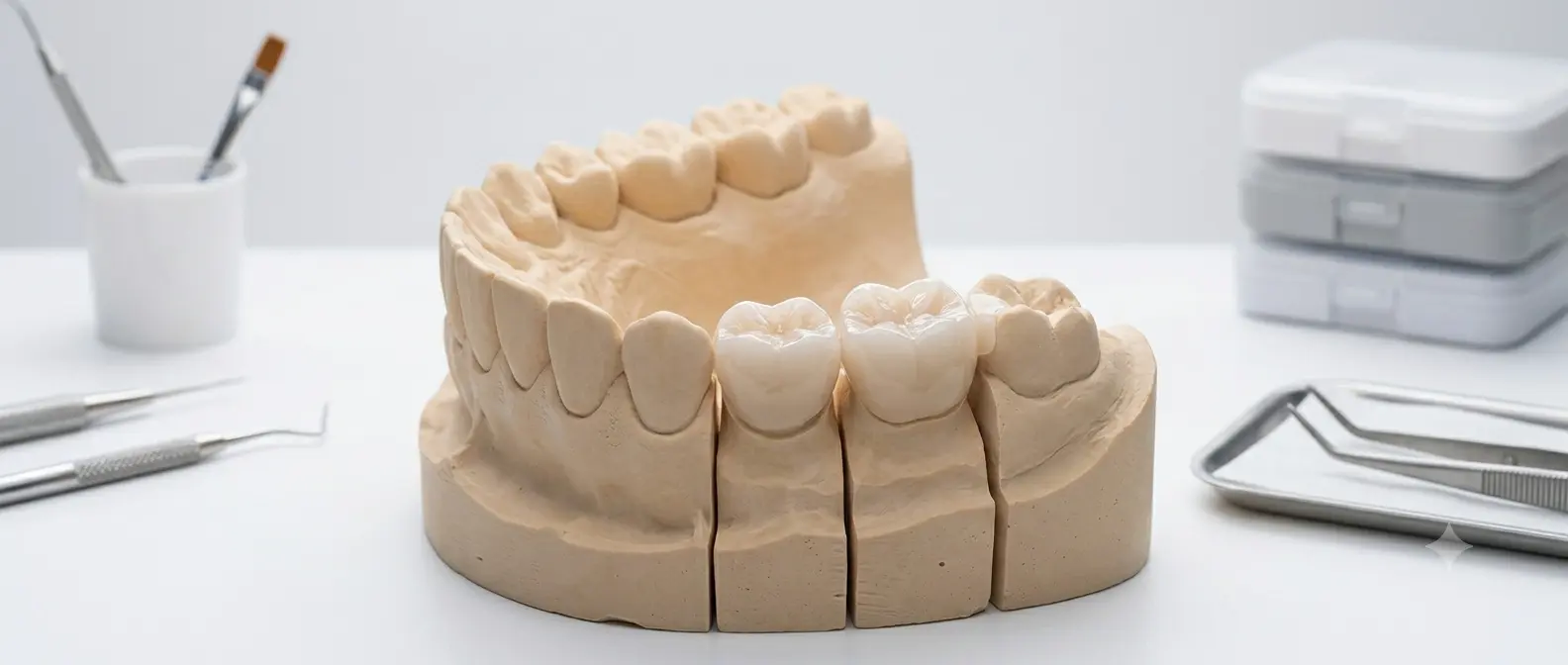
The inlay or onlay is fabricated in our on-site laboratory from the digital scan data. The shade is matched precisely to the surrounding tooth structure. Direct dentist-technician communication ensures the contours, contact points, and marginal fit are exactly right before the patient returns for cementation.
Fitting & Permanent Bonding
The inlay or onlay is tried in dry first — shade, fit, and occlusion are all verified before any cement is applied. Once confirmed, it is bonded permanently with a high-strength resin cement. The bite is adjusted and the margins polished. You leave with a fully finished, permanent restoration.
Inlay & Onlay Cost in Albania
All prices include preparation, temporary restoration, in-house laboratory fabrication, cementation, and follow-up.
| Restoration | Kocaqi — Tirana | Western Europe avg. | Saving |
|---|---|---|---|
| E-max Ceramic Inlay | from €150 | €500 – €900 | ~73% |
| E-max Ceramic Onlay | from €160 | €600 – €1,000 | ~73% |
| Zirconia Inlay / Onlay | from €170 | €600 – €1,000 | ~73% |
| Composite Inlay (direct) | from €90 | €200 – €500 | ~70% |
Prices are per restoration unit. All costs confirmed in writing before treatment begins. No hidden fees.
Inlays & onlays — questions answered
What is the difference between an inlay and an onlay?
An inlay fills the space between the cusps of the tooth — restoring the central chewing surface without extending over the outer walls. An onlay covers one or more of the outer cusps in addition to the central surface — providing greater structural reinforcement when the damage extends to the sides of the tooth. The choice between the two is determined by the extent of the cavity and how much tooth structure remains after preparation.
Why choose an inlay instead of a crown?
A crown requires shaping the entire tooth — removing significant amounts of healthy enamel and dentine from all surfaces to allow the crown to fit over it. An inlay or onlay is considerably more conservative: only the damaged and decayed tooth structure is removed, and the restoration fits precisely into that space. If the tooth has adequate structural integrity in its remaining walls, an inlay or onlay preserves far more of what nature provided — which is always preferable. A crown becomes the right choice when the tooth is structurally too compromised for a partial coverage restoration.
How long do ceramic inlays and onlays last?
E-max ceramic inlays and onlays typically last 15 years or more with normal oral hygiene and regular check-ups. The primary factors affecting longevity are biting habits (bruxism significantly increases the risk of ceramic fracture), oral hygiene at the margins, and the integrity of the original preparation and cementation. All inlays and onlays placed at Kocaqi Dental are covered by our standard restoration guarantee.
Is getting an inlay or onlay painful?
The preparation appointment is performed under local anaesthesia and is painless. Some sensitivity on the prepared tooth while the temporary is in place is normal and resolves once the permanent restoration is cemented. If the tooth had significant pre-existing decay, there may be mild sensitivity initially as the tooth settles — this is common and temporary.
Preserve more tooth. Restore full strength. Look completely natural.
Send us photographs and any existing X-rays of the tooth you need treated. We'll confirm whether an inlay or onlay is the right restoration, and provide a transparent written quote within 24 to 48 hours.
E-max ceramic inlay from €150 · Onlay from €160 · In-house lab · 5-day turnaround · Save 73%