
Fiber Post in Tirana, Albania
A devitalized tooth after root canal treatment needs internal structural support before a crown can be placed. A fiber post anchored in the root canal provides the foundation — distributing forces safely, bonding with the tooth, and maximising the long-term survival of the restored tooth.
What is a fiber post?
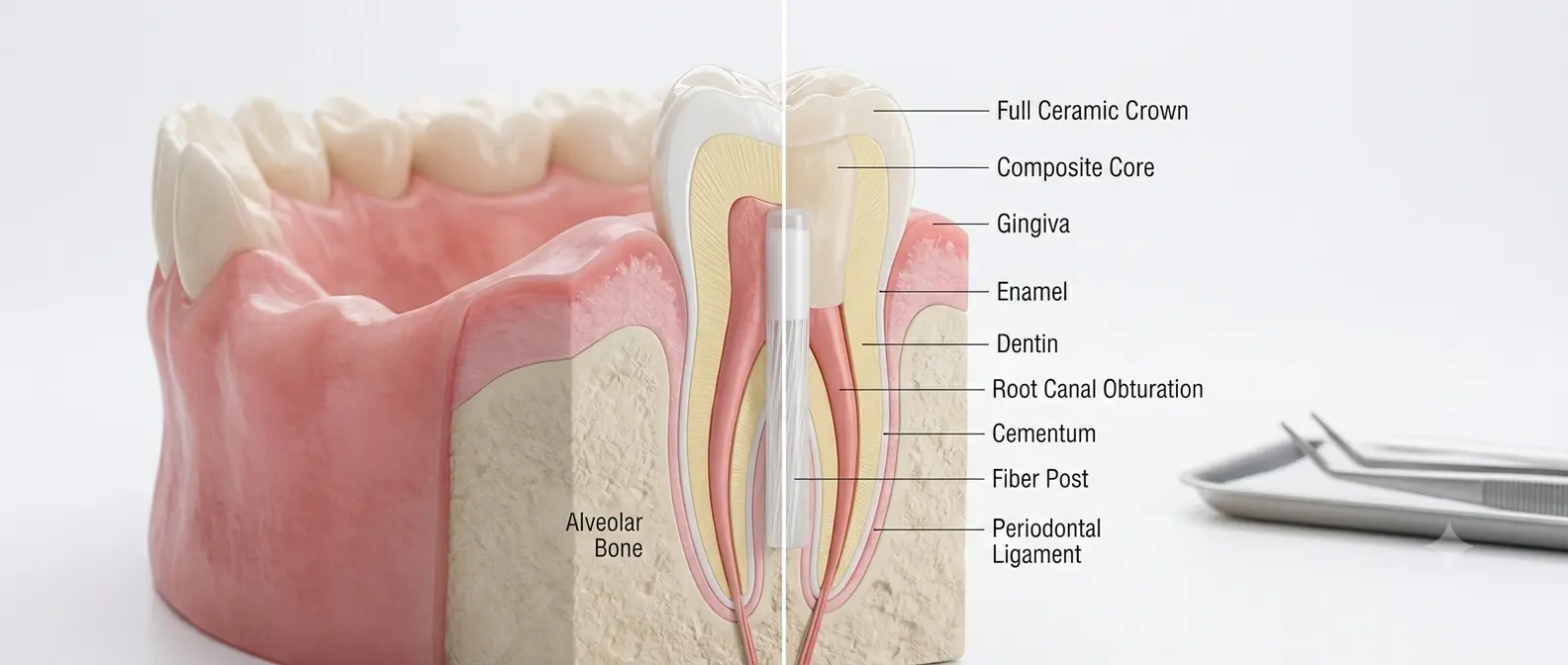
A fiber post is a thin, tooth-coloured rod made of glass or quartz fibers embedded in a resin matrix. It is cemented into the prepared root canal of a devitalized tooth (one that has undergone root canal treatment) to provide the structural anchor onto which a composite core build-up and final crown are placed.
Unlike traditional metal posts, fiber posts have an elastic modulus that closely matches natural dentine — meaning they flex with the tooth under biting forces rather than creating a rigid stress concentration. This fundamental difference significantly reduces the risk of catastrophic root fracture, which is the primary failure mode associated with metal post-and-core systems.
- Elasticity matches natural dentine — reduces root fracture risk
- Tooth-coloured — no dark shadow through ceramic crown
- Bonds chemically to the root canal wall — monobloc effect
- No corrosion — no metallic staining of gum tissue over time
- MRI-compatible — no interference with imaging
- Placed in a single appointment alongside crown preparation
Why fiber posts have replaced metal in modern dentistry
Metal post-and-core systems were the standard for decades. Current clinical evidence and material science consistently favour fiber posts for most post-endodontic restorations.
| Factor | Fiber Post | Metal Post |
|---|---|---|
| Elastic modulus vs dentine | Similar — flexes with tooth | Far higher — rigid stress concentrator |
| Root fracture risk | Low — fracture tends to be repairable | Higher — catastrophic vertical fractures |
| Aesthetics | Tooth-coloured — no shadow | Dark shadow visible through ceramic |
| Adhesion to root | Chemical bond — monobloc system | Mechanical retention only |
| Gum tissue | No staining over time | Metallic grey staining possible |
| MRI compatibility | Fully compatible | May cause artefacts |
| Retrieval if needed | Possible with ultrasonics | Possible but higher risk to root |
Three layers — one restored tooth
A fiber post is not the final restoration — it is the first of three layers that together rebuild a devitalized tooth from root to crown.
The Fiber Post
Cemented into the prepared root canal space, extending 2/3 into the root. Provides axial reinforcement and a retention anchor for the build-up. Glass fiber construction with resin matrix — biocompatible, tooth-coloured, and elastically matched to dentine.
The Composite Core Build-Up
A dental composite material built up around the exposed post and remaining tooth structure to recreate the full coronal shape of the tooth. The core provides the bulk needed for the crown preparation to be carried out — giving the crown adequate thickness for strength and aesthetics.
The Crown
An E-max or Zirconia crown placed over the built-up tooth structure completes the restoration. The crown provides the outer layer of protection, aesthetics, and biting force distribution. Together, post + core + crown form a complete, lasting reconstruction of the devitalized tooth.
The fiber post procedure
Placed in a single appointment — typically alongside crown preparation, on the same day.
Root Canal Review & Post Space Planning
Before post placement, the root canal treatment is reviewed radiographically — confirming the fill is adequate, the root length is sufficient, and that no complications are present. Post length and diameter are selected based on root dimensions measured from the X-ray. Not every root canal treated tooth requires a post — the decision depends on how much natural coronal tooth structure remains.
Canal Enlargement
Under local anaesthesia (or without anaesthesia if the tooth is fully devitalized), a portion of the root canal filling is removed using a calibrated post drill to the planned depth — leaving a minimum of 4–5 mm of remaining gutta-percha at the apex to maintain the seal. The post space is cleaned and conditioned.
Fiber Post Bonded into Place
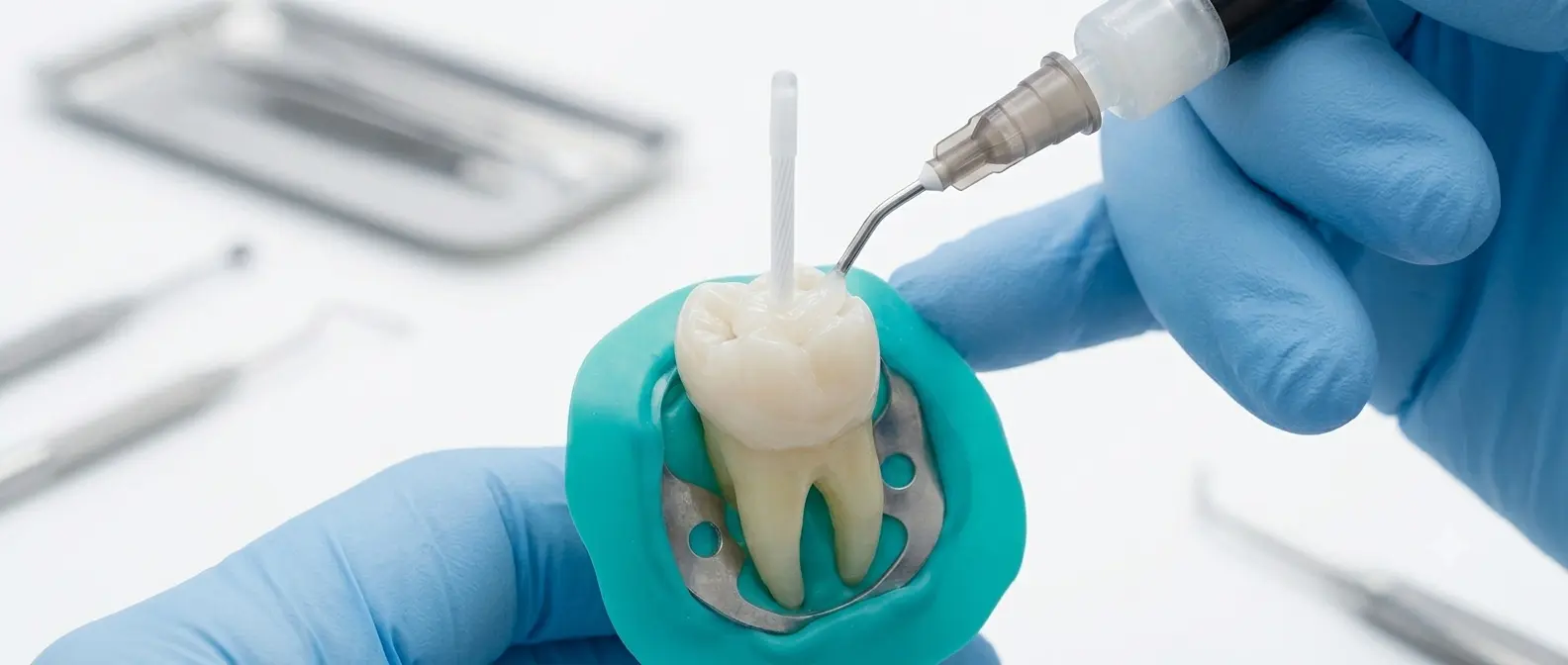
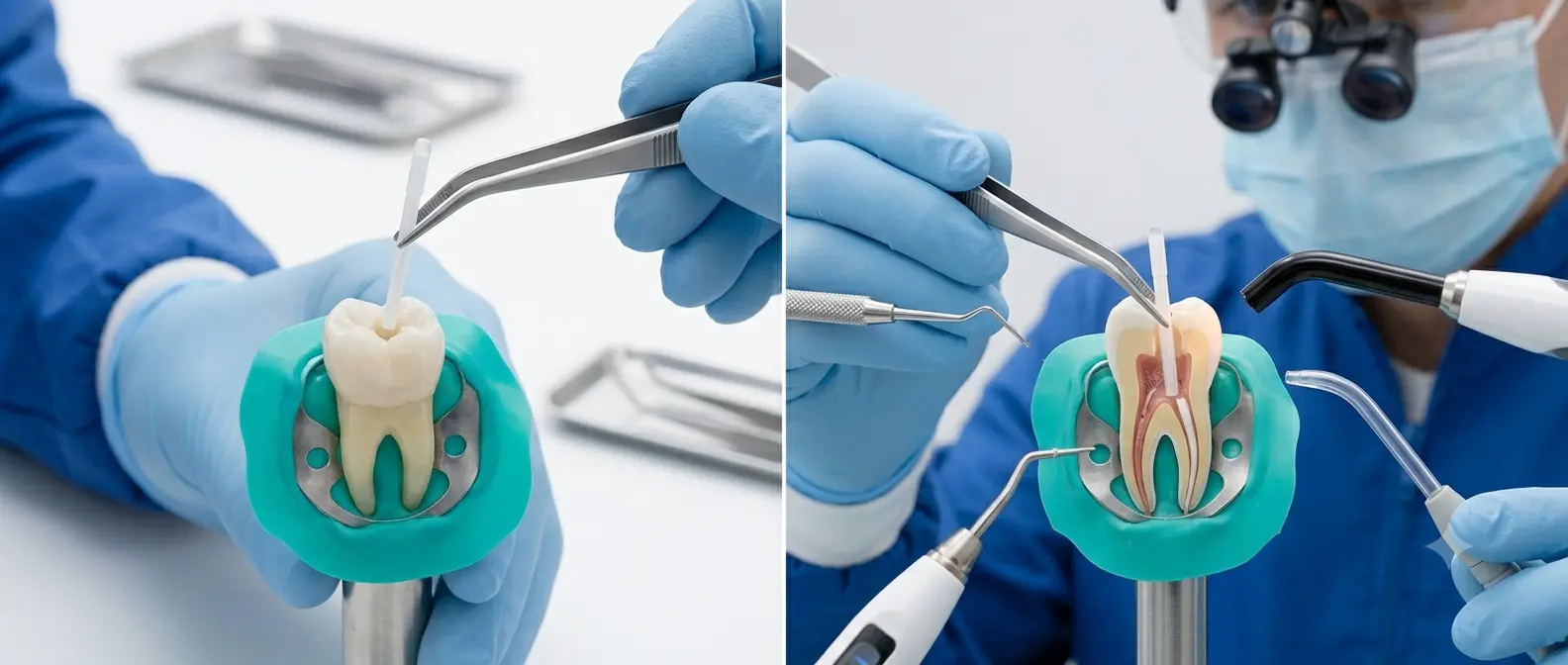
The prepared canal is etched, primed, and an adhesive bonding agent applied. The fiber post is coated with silane and adhesive, then seated into the canal and light-cured. The chemical bond between post, cement, and root dentine creates the monobloc effect — making the entire root-post-cement unit act as a single structure under load.
Composite Core Placed
Composite core material is built up around the exposed portion of the post and any remaining tooth structure, sculpting the shape needed for crown preparation. The core is light-cured and trimmed to the ideal shape. Crown preparation follows immediately — the tooth is now prepared, scanned digitally, and a temporary crown placed, all in the same appointment.
Fiber Post Cost in Albania
The fiber post and core build-up are priced as a unit — typically placed at the same appointment as crown preparation. All prices are per tooth.
| Procedure | Kocaqi — Tirana | Western Europe avg. | Saving |
|---|---|---|---|
| Fiber Post + Composite Core Build-Up | from €50 | €150 – €350 | ~70% |
| Fiber Post + Core + E-max Crown | from €230 | €900 – €1,500 | ~75% |
| Fiber Post + Core + Root Canal + Crown | from €360 | €1,500 – €2,500 | ~75% |
The fiber post fee covers the post, core composite, and all bonding materials. Crown fabrication and cementation are included in the crown fee. Full package pricing (root canal + post + crown) is available at a combined rate — ask for a package quote.
Fiber post — questions answered
Does every root canal treated tooth need a fiber post?
No. A post is indicated when the remaining coronal tooth structure is insufficient to retain a core build-up on its own. If the tooth retains most of its walls and is simply missing one cusp or a small portion, a direct composite build-up without a post may be sufficient. The decision is made based on how much natural tooth structure remains after the root canal — assessed clinically and radiographically before treatment begins.
Why is a fiber post better than a metal post?
The key advantage is elastic modulus — fiber posts flex under load at a rate close to natural dentine, while metal posts are far stiffer and concentrate stress at the root. Under repeated biting loads, a metal post can cause the root to fracture vertically — a catastrophic failure that often means the tooth must be extracted. With a fiber post, any failure tends to occur in the core or crown, which can be replaced, leaving the root intact. Additionally, fiber posts are tooth-coloured (no dark shadow through ceramic crowns), bond chemically to the root, and are MRI-compatible.
Is fiber post placement painful?
The procedure is performed on a tooth that has already had root canal treatment — meaning the nerve has been removed. In most cases, no anaesthesia is required at all. Some patients prefer a small amount of local anaesthetic for comfort during the crown preparation that follows, which we provide on request.
How long does a fiber post last?
A correctly placed fiber post in a properly restored tooth has an excellent long-term prognosis. Clinical studies report 10-year tooth survival rates exceeding 95% for fiber post + core + crown combinations. The post itself is designed to be permanent — clinical failure, when it occurs, almost always involves the crown or core rather than the post itself.
Fiber post + crown — your devitalized tooth restored for life
If you have had a root canal and need a crown, send us your X-rays. We'll assess whether a fiber post is indicated, plan the complete restoration, and provide a full package quote — root canal, post, and crown — within 24 to 48 hours.
Post + core from €50 · Complete root canal + post + crown from €360 · Same-day placement · Save 75%