
Bone Grafting in Tirana, Albania
When implants are not possible due to insufficient bone, bone grafting rebuilds the volume needed — adding bone exactly where it is required so that implants can be placed with full stability and long-term success.
What is bone grafting?
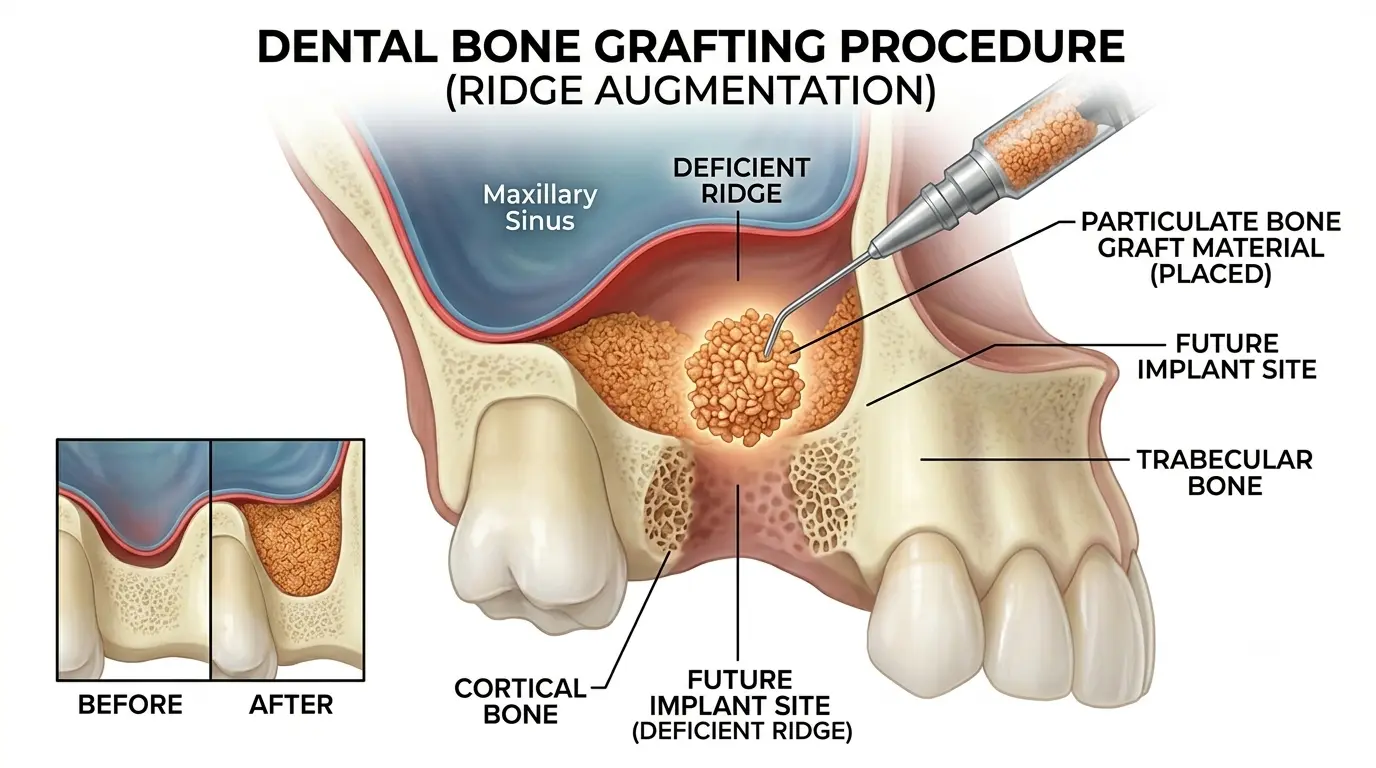
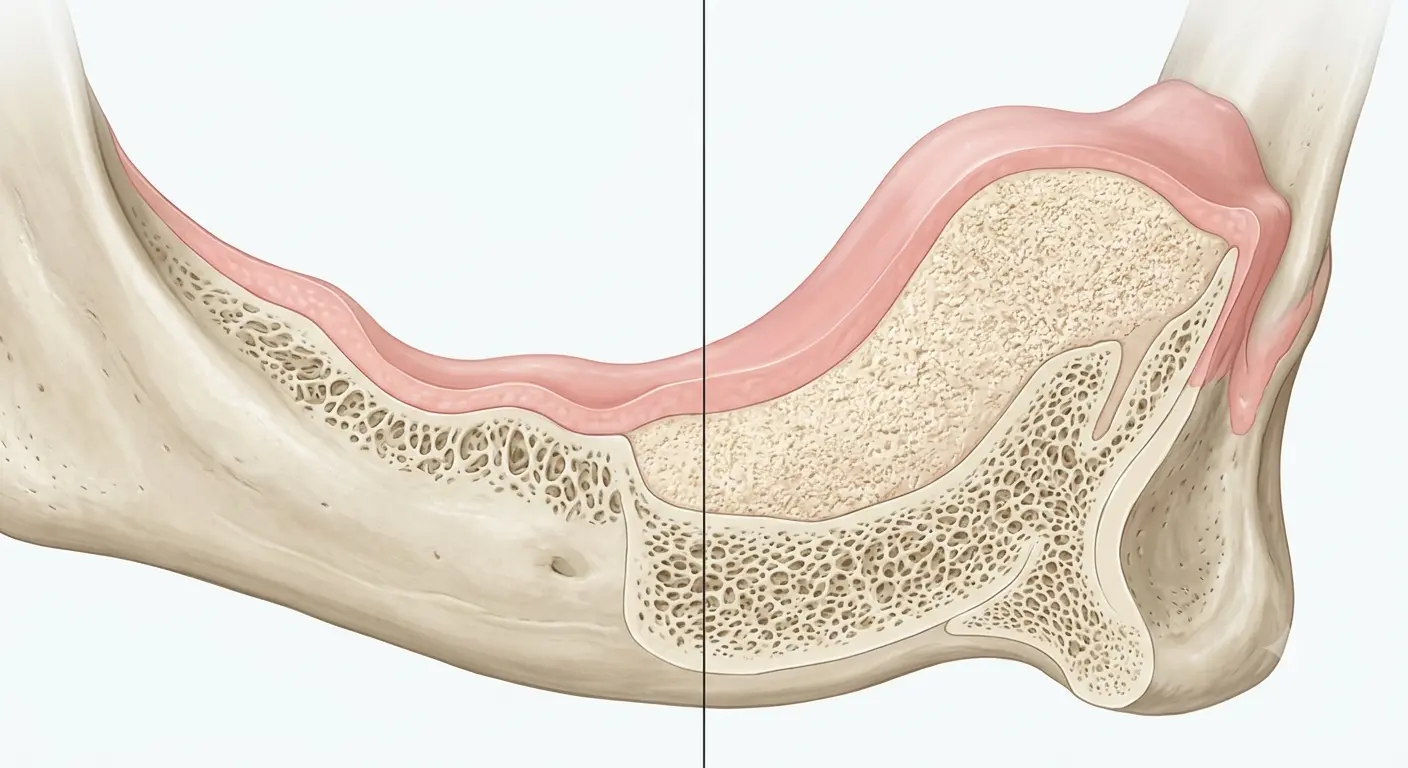
Bone grafting is a surgical procedure that adds bone volume to areas of the jaw where it has been lost through tooth extraction, periodontal disease, trauma, or long-term absence of teeth. The graft material acts as a scaffold that the patient's own body gradually replaces with living bone over 3 to 6 months.
Once sufficient bone volume is established, dental implants can be placed into the grafted site with the same stability and long-term outcomes as in patients with naturally adequate bone. Bone grafting opens the door to implant treatment for patients who would otherwise be excluded.
- Rebuilds lost bone volume precisely where needed
- Graft material replaced by patient's own bone over 3–6 months
- Enables implant placement that would otherwise be impossible
- Simultaneous implant placement possible in many cases
- In-house CBCT for precise bone volume assessment
- 95%+ implant survival rate on grafted bone
Four grafting procedures — one right for your situation
The type of graft required depends on where bone is missing, how much volume needs to be rebuilt, and the planned implant configuration.
Socket Preservation Graft
Performed immediately after tooth extraction to prevent the bone from collapsing into the empty socket. Placing graft material at the time of extraction maintains the ridge width and height, preserving the site for future implant placement. Avoids the more complex ridge augmentation that becomes necessary if the socket is left to collapse.
Ridge Augmentation
Rebuilds the width or height of a collapsed or atrophied bone ridge. Graft material is placed on the outer surface of the existing bone and covered with a collagen membrane that holds it in place while new bone forms beneath. The primary preparation for implants in a site where the bone has already resorbed significantly.
Vertical Bone Augmentation
The most technically demanding grafting procedure — rebuilding bone height (vertical dimension) that has been lost. Used when the jaw has become so thin vertically that standard implants cannot achieve adequate depth. Often combined with titanium mesh or membranes for space maintenance during healing.
Sinus Augmentation
A specialised graft for the upper posterior jaw where the maxillary sinus has expanded into the available bone space. See our dedicated Sinus Lift page for full details on this procedure.
Four material options — chosen for your case
The graft material acts as a scaffold for new bone growth. Different materials have different properties and clinical applications — the right choice depends on your anatomy, the volume needed, and clinical preference.
Autogenous Bone
Patient's own bone — harvested from the jaw, chin, or ramus. The gold standard biologically; contains living bone cells and growth factors. Requires a second surgical site.
Xenograft
Deproteinised bovine bone — the most extensively studied graft material. Provides an excellent scaffold for bone ingrowth. No donor site needed. Used in the majority of ridge augmentation and socket preservation cases.
Synthetic Substitute
Hydroxyapatite or beta-TCP — biocompatible ceramic materials that mimic bone mineral structure. Predictable, no donor site, available in different particle sizes for different applications.
Combination
A mix of autogenous bone and synthetic or xenograft material — combining the biological activity of patient's own bone with the volume stability of substitute material. Increasingly preferred for larger augmentations.
The bone grafting process
From CBCT assessment to healed bone ready for implants.
CBCT Scan & Bone Volume Mapping
A cone beam CT scan measures the exact dimensions of available bone — width, height, and density — at the planned implant site. This determines which grafting procedure is required, how much volume needs to be rebuilt, and whether simultaneous implant placement is feasible. No bone graft is planned from a 2D X-ray alone.
Bone Graft Placement
Under local anaesthesia, the graft material is placed at the deficient site. A resorbable collagen membrane is placed over the graft to contain it and protect it during healing. Where simultaneous implant placement is possible — when primary stability can be achieved despite limited bone — implants are placed in the same session. The site is carefully sutured closed.
Bone Formation
The graft material is gradually resorbed and replaced by the patient's own bone through a process called osteogenesis. This takes 3 to 6 months depending on the volume grafted and the graft material used. Healing is monitored remotely — progress imaging is reviewed before scheduling implant placement. No visits to Tirana are needed during this phase.
Implants Placed in New Bone
Once imaging confirms adequate bone volume and density, implants are placed exactly as in a standard implant case. The new bone behaves identically to native bone — implants placed in well-grafted sites show equivalent long-term survival rates to those placed in naturally adequate bone.

Bone Grafting Cost in Albania
Bone graft pricing depends on the type of procedure and the volume of material required. All prices include surgery, anaesthesia, graft material, membrane, and post-operative review.
| Procedure | Kocaqi — Tirana | Western Europe avg. | Saving |
|---|---|---|---|
| Socket Preservation (per site) | from €120 | €300 – €700 | ~70% |
| Ridge Augmentation (per site) | from €150 | €500 – €1,500 | ~70% |
| Vertical Bone Augmentation | Get a quote | €1,500 – €4,000 | ~70% |
| Bone Graft + Single Implant (same session) | from €520 | €2,000 – €4,500 | ~70% |
Pricing depends on graft type, material, and volume. Confirmed from CBCT data before treatment begins. All costs in writing before any commitment.
Bone grafting — questions answered
Is bone grafting painful?
The procedure is performed under local anaesthesia and is painless during surgery. Post-operative discomfort is similar to a tooth extraction — soreness and mild swelling for 3 to 5 days, manageable with prescribed pain relief. The recovery is generally straightforward with no diet restrictions beyond the first few days of soft food.
How long does bone grafting take to heal?
Bone formation takes 3 to 6 months depending on the graft size and material used. Larger augmentations and vertical grafts take longer than socket preservation procedures. Healing is confirmed radiographically before implant placement is scheduled — we never proceed to implants on a fixed timeline regardless of imaging.
Can implants be placed at the same time as a bone graft?
In many cases, yes — particularly for socket preservation and ridge augmentation where there is sufficient residual bone to achieve implant stability. Simultaneous placement eliminates one surgical session and reduces total treatment time. Whether it is appropriate is determined by the CBCT data and the stability achieved at surgery.
What happens if I don't graft after an extraction?
Without socket preservation, the bone naturally resorbs into the empty socket over the first 12 months following extraction — losing up to 40–50% of width in the first year. This makes subsequent implant placement more complex and potentially requires a more extensive ridge augmentation procedure rather than the simpler socket graft that could have been placed at extraction time.
We can rebuild the foundation your implants need
Send us your X-rays and we'll assess your bone volume, confirm which grafting procedure applies, and provide a full written quote — including implant placement — within 24 to 48 hours. Free, no obligation.
Socket preservation from €120 · Ridge augmentation from €150 · Same-session implants · In-house CBCT · Save 70%