
Root Canal Treatment in Tirana, Albania
Save your natural tooth — in a single appointment. Painless, efficient endodontic treatment that eliminates infection and preserves the tooth you were told you might lose, at up to 70% less than prices at home.
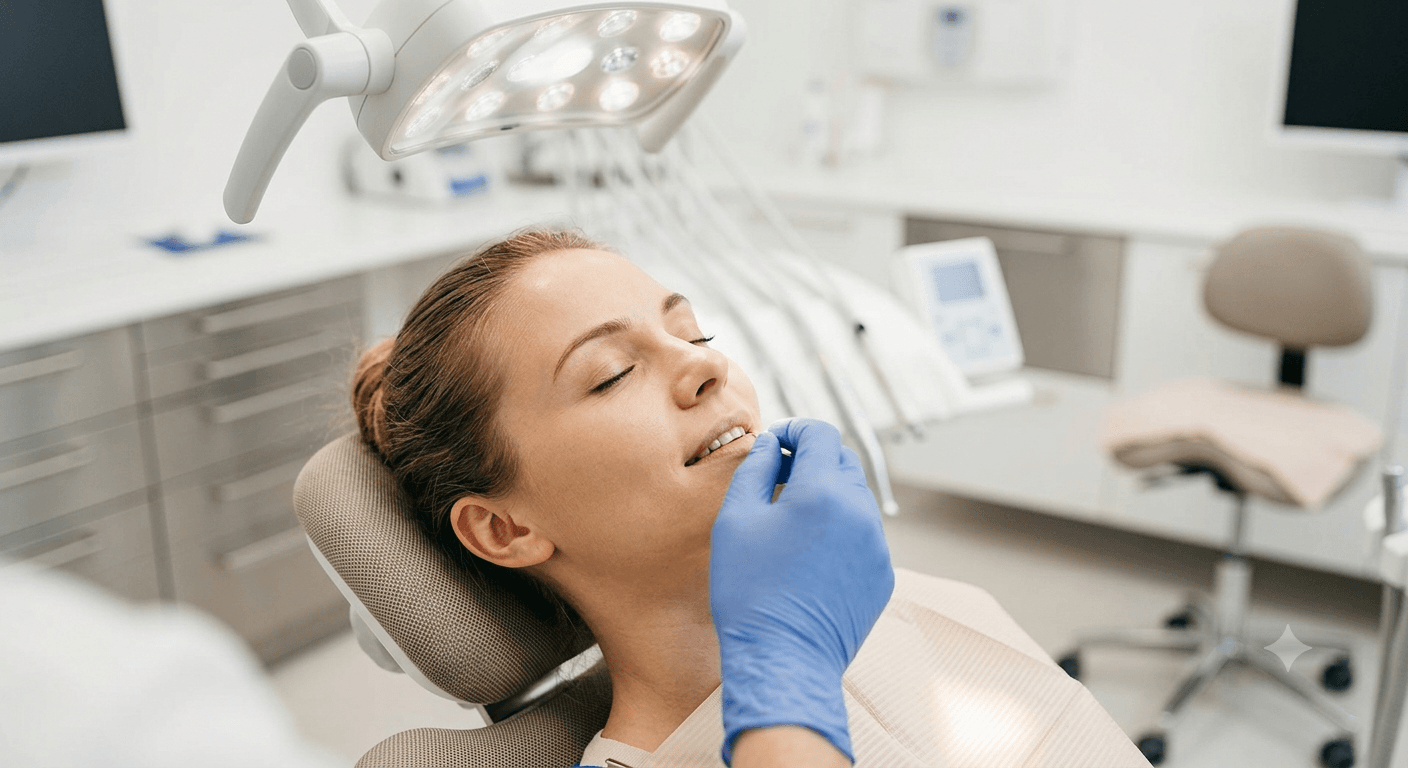
Signs you may need root canal treatment
These symptoms indicate that the pulp — the soft tissue inside your tooth containing the nerve and blood vessels — may be infected or dying. Root canal treatment removes the infection and saves the tooth before extraction becomes unavoidable.
Severe or Persistent Toothache
Deep, throbbing pain that does not resolve — especially pain that wakes you at night or is not relieved by painkillers.
Prolonged Sensitivity to Hot or Cold
Pain from hot or cold that lingers for more than a few seconds after the stimulus is removed — a sign of irreversible pulp inflammation.
Swelling or Abscess
A visible swelling in the gum, face, or jaw — or a pimple-like bump on the gum — indicating a dental abscess caused by pulp infection spreading to the surrounding bone.
Tooth Darkening or Discolouration
A single tooth that has gradually turned grey or dark — often indicating the pulp has died, even without pain. The tooth still requires treatment to prevent further infection.
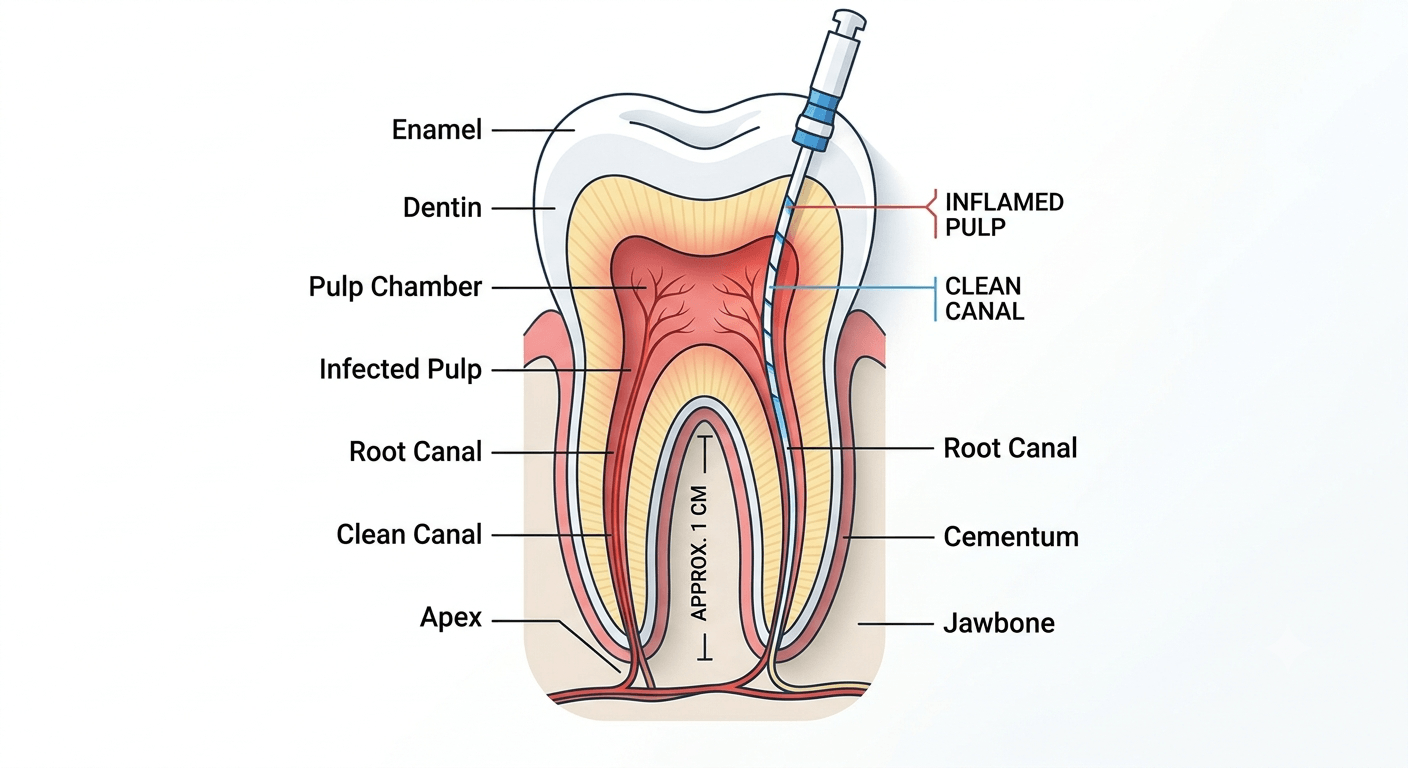
What is root canal treatment?
Root canal treatment — also called endodontic treatment — is the procedure that removes infected or inflamed pulp tissue from inside the tooth, cleans and shapes the root canal system, and seals it permanently to prevent reinfection. Despite its fearsome reputation, modern root canal treatment is no more uncomfortable than having a filling placed.
The goal is simple: save the natural tooth. A tooth treated with root canal, then protected with a dental crown, can remain in function for decades — often for a lifetime. The alternative — extraction — leads to bone loss, shifting teeth, and the eventual need for an implant or bridge that costs significantly more.
- Saves the natural tooth — no extraction needed
- Eliminates infection and pain permanently
- Performed under local anaesthesia — painless during treatment
- Completed in a single visit at Kocaqi Dental
- Far less costly than extraction + implant
- 98% long-term success rate when followed by a crown
Single-visit root canal — completed in one appointment
Traditionally, root canal treatment required two or three appointments spread over several weeks. At Kocaqi Dental, we complete most root canal cases in a single appointment — meaning international patients can have the entire treatment done and dusted on day one of their visit, with no need to return for a second endodontic session.
- Full root canal completed in 60 to 90 minutes
- No temporary dressing — permanent seal placed same day
- Ideal for dental tourists — no return trip for endodontics
- Crown preparation can begin the following day
- Reduces total treatment time by 1 to 3 weeks vs multi-visit
- Same clinical outcome as multi-visit for most cases
The root canal procedure — what happens during your appointment
Modern root canal treatment is a precise, well-structured procedure. Here is exactly what takes place during your single-visit appointment at Kocaqi Dental.
Online Assessment & X-Ray Review
Send us your dental X-rays (periapical or panoramic) and a brief description of your symptoms. We assess whether root canal treatment is indicated, whether the tooth is restorable, and provide a written quote within 24 to 48 hours. If you don't have X-rays, we take them on arrival — a full periapical X-ray is included in the treatment fee.
Local Anaesthesia & Dental Dam Placement
Profound local anaesthesia is administered and confirmed before any work begins — you will feel pressure but no pain throughout. A rubber dental dam is placed around the tooth to isolate it completely, maintaining a sterile field and preventing any irrigant or instrument from reaching the throat. This is standard protocol for all root canal procedures.
Access, Pulp Removal & Canal Shaping
A small access opening is made through the top of the tooth. The infected or necrotic pulp tissue is removed using rotary nickel-titanium files, which simultaneously shape each canal to a precise taper. Electronic apex locators determine the exact working length of each canal with millimetre accuracy — no guesswork, no over-instrumentation. The canals are continuously irrigated with sodium hypochlorite solution to dissolve remaining organic tissue and disinfect the canal walls.
Final Irrigation & Canal Drying
A final irrigation sequence using EDTA and sodium hypochlorite removes the smear layer from canal walls and achieves the deepest possible disinfection before obturation. The canals are then thoroughly dried with paper points — moisture in the canal at this stage would compromise the seal of the root filling.
Permanent Root Filling
The cleaned and shaped canals are filled permanently with gutta-percha — a biocompatible rubber-like material — and sealed with a root canal sealer using warm vertical compaction. A post-operative X-ray confirms complete fill to the apex with no voids. The access cavity is then restored with a build-up material, and the tooth is ready for crown preparation — which can begin the following day.
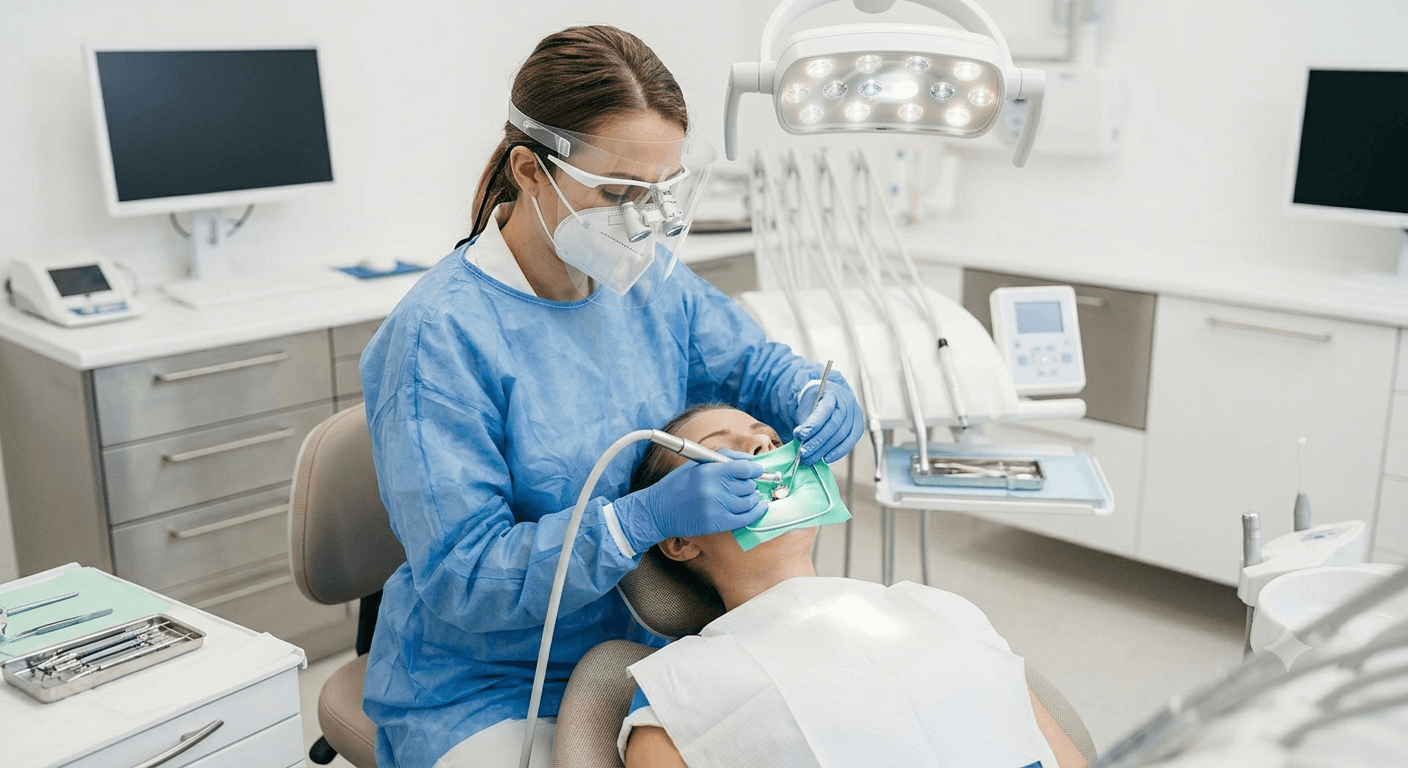
A crown is almost always needed after root canal treatment
Root-treated teeth — especially molars and premolars — lose structural integrity over time and are highly prone to vertical fracture without crown protection. A dental crown placed promptly after root canal treatment is the single most important factor in long-term tooth survival. At Kocaqi Dental, crown preparation begins the day after root canal completion — both treatments are coordinated in a single trip, with no additional visit needed.
Root Canal Treatment Cost in Albania
Root canal pricing depends on the tooth being treated and the number of root canals it contains. All prices below are all-inclusive: anaesthesia, instrumentation, irrigation, obturation, and post-operative X-ray. Crown is quoted and priced separately.
| Treatment | Kocaqi — Tirana | Western Europe avg. | Saving |
|---|---|---|---|
| Incisor / Canine (1 canal) | from €80 | €300 – €600 | ~75% |
| Premolar (1–2 canals) | from €100 | €400 – €700 | ~75% |
| Molar (3–4 canals) | from €130 | €600 – €1,200 | ~80% |
| Root canal retreatment (existing failed RCT) | Get a quote | €700 – €1,500 | ~75% |
| Root canal + Crown package | from €210 | €1,200 – €2,200 | ~80% |
Prices shown are starting points. Retreatment cases and teeth with calcified or curved canals may be priced differently — assessed individually from your X-rays before treatment begins. No hidden fees. All costs confirmed in writing before your appointment.
Why patients choose Kocaqi for root canal treatment
Single-Visit Completion
We complete most root canal cases in one appointment of 60 to 90 minutes. No temporary dressings, no return visits for endodontics. Crown preparation can begin the following morning — your entire treatment is coordinated within a single trip to Tirana.
Rotary NiTi Instrumentation
We use nickel-titanium rotary files for canal shaping — the current standard of care in endodontics. NiTi files are flexible enough to follow curved canals precisely, reducing the risk of ledging, perforation, or instrument separation compared to manual stainless steel files.
Electronic Apex Locators
Working length is determined electronically — not estimated from X-rays alone. Electronic apex locators provide accurate canal length measurements in real time, ensuring the filling reaches the correct endpoint without over- or under-instrumentation.
Crown Under One Roof
Root canal and crown — both performed in-house by the same coordinated team, in the same trip. No referrals, no different providers, no records to transfer. Your post-endodontic crown is fabricated in our in-house laboratory and delivered within 3 to 4 days of your root canal appointment.
Painless — Genuinely
The reason root canals have a bad reputation is poor anaesthesia technique, not the procedure itself. We do not begin treatment until complete profound anaesthesia is confirmed. The vast majority of patients report that their root canal was easier than they expected — and less uncomfortable than the pain that brought them to us.
25+ Years of Experience
Dr. Hysen Kocaqi and the clinical team have performed thousands of root canal treatments over 25+ years. Complex cases — calcified canals, curved roots, retreatments of previously failed root canals — are handled in-house without referral to a specialist in the majority of cases.
Root canal treatment — your questions answered
Is root canal treatment painful?
No — when performed under adequate local anaesthesia, root canal treatment is not painful. You will feel pressure and movement, but no sharp pain. The procedure has an undeserved reputation largely because many patients have had treatment in the past when anaesthetic techniques were less refined. At Kocaqi Dental, we confirm profound anaesthesia before starting and do not proceed until the tooth is fully numb. Most patients are surprised by how comfortable the appointment is.
How long does a root canal appointment take?
A single-visit root canal at Kocaqi Dental typically takes 60 to 90 minutes for a straightforward case. Molars with 3 or 4 canals, or teeth with particularly curved or calcified root canals, may take slightly longer. You will be advised of the expected duration when your case is assessed from your X-rays before treatment begins.
Will I need a crown after root canal treatment?
For molars and premolars — almost always yes. Root-treated posterior teeth are significantly more prone to vertical fracture, and a crown is the standard of care that protects them for the long term. For front teeth with minimal remaining structure, a crown is also recommended. For front teeth with most of the natural crown intact, a composite build-up may be sufficient in some cases — assessed individually at your appointment.
What happens if I don't have root canal treatment?
A tooth with infected or necrotic pulp will not heal on its own. Without treatment, the infection spreads into the bone causing an abscess, chronic bone destruction, and eventually tooth loss. In some cases, dental infections can spread beyond the jaw — a serious medical situation. Root canal treatment now is always preferable to extraction later, both clinically and financially: a dental implant to replace a lost tooth costs significantly more than root canal plus crown to save it.
Can a previously root-treated tooth be retreated?
Yes — root canal retreatment is possible in most cases where the original treatment has failed (persistent infection, missed canals, inadequate fill, or coronal leakage). The original root filling is removed, the canals are reshaped and disinfected, and the tooth is re-obturated. Retreatment cases are more complex than primary root canals and are assessed individually — send us your X-rays for an evaluation.
Is it better to save a tooth with root canal or extract and implant?
Save the tooth when possible — always. A natural tooth with a well-done root canal and crown has a 10-year survival rate of over 90%. Extraction followed by an implant costs more, takes longer, and involves a surgical procedure. Implants are an excellent solution when a tooth genuinely cannot be saved — but root canal treatment should always be the first option evaluated. We give an honest assessment of restorability before recommending any treatment.
How long does a root-treated tooth last?
A root-treated tooth protected by a crown has a reported 10-year survival rate of approximately 90 to 98% in the published literature. Many root-treated teeth remain functional for 20 to 30 years or more. The primary factors affecting longevity are: the quality of the crown placed on top, oral hygiene around the crown margin, and whether the tooth is subject to excessive biting forces.
Don't wait — a dental infection will not resolve on its own
Send us your X-rays or photos and a description of your symptoms. We'll assess your case within 24 hours, confirm whether root canal is the right treatment, and provide a transparent written quote — free, with no obligation to proceed.
Single visit · Painless · From €80 · Crown same trip · Save up to 80%