
Sinus Lift in Tirana, Albania
When there is not enough bone in the upper jaw for dental implants, a sinus lift creates the foundation needed — adding bone precisely where it is required, so implants can be placed with full stability and long-term success.
Why some patients need bone added before implants
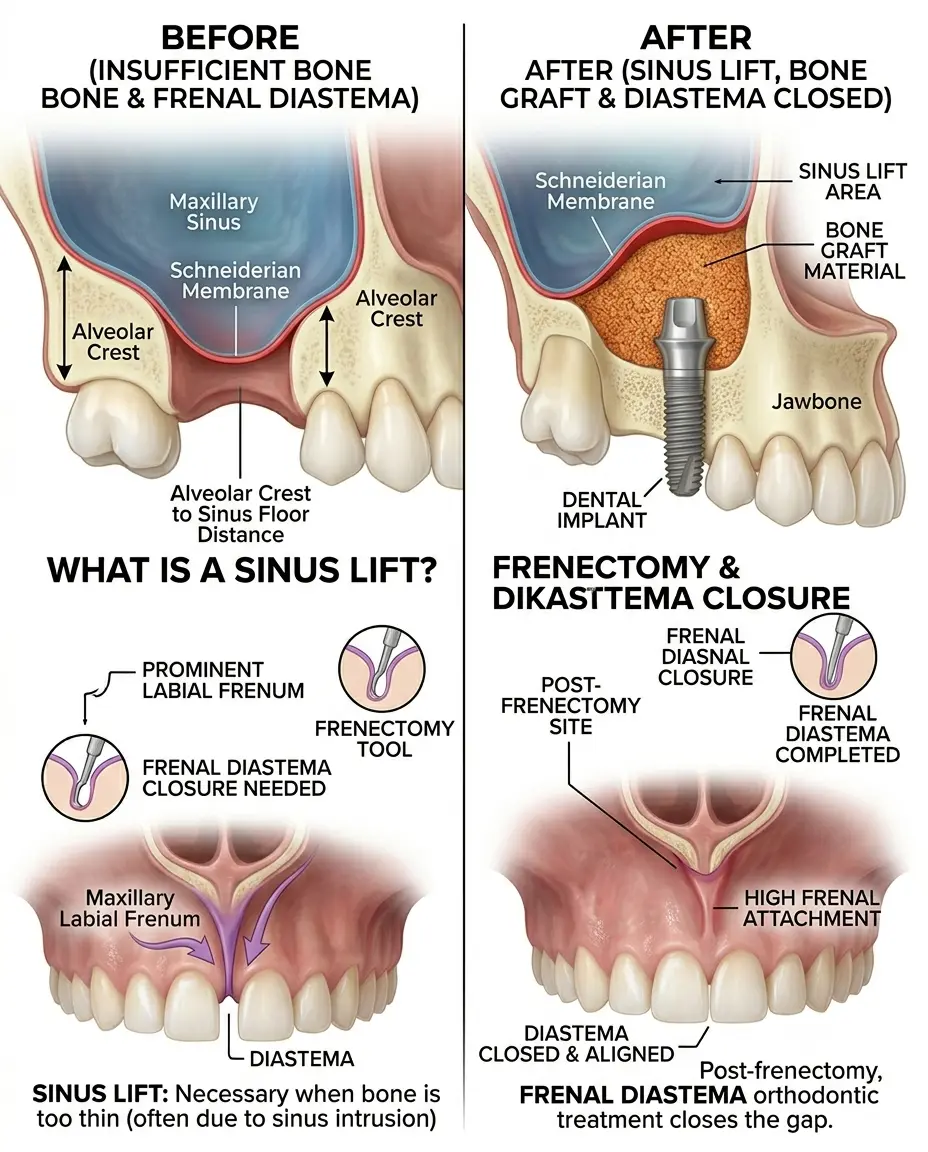
The maxillary sinus sits just above the upper back teeth. When these teeth are missing, the sinus can expand downward and bone resorbs upward — leaving insufficient height for a standard implant. A sinus lift rebuilds this space.
Missing Upper Back Teeth
After the upper molars or premolars are lost, the alveolar bone beneath the sinus resorbs progressively — often leaving less than 5 mm of usable bone height, insufficient for standard implant placement.
Sinus Pneumatisation
The maxillary sinus naturally expands (pneumatises) after tooth loss, filling the space previously occupied by tooth roots. This progressive expansion further reduces the available bone height over time.
Naturally Low Sinus Floor
Some patients have anatomically low sinus floors regardless of tooth loss history — a genetic variation that means they require a sinus lift even when replacing recently extracted teeth.
What is a sinus lift?
A sinus lift — formally known as sinus augmentation or maxillary sinus floor elevation — is a surgical procedure that increases the amount of bone in the upper jaw by gently lifting the sinus membrane upward and placing bone graft material into the resulting space between the jaw and the sinus floor.
Over 4 to 6 months, the graft material is gradually replaced by the patient's own living bone through a process called osseointegration — creating a solid, natural bone foundation into which dental implants can be placed with the same stability and long-term success as in patients with naturally adequate bone volume.
- Creates sufficient bone height for implant placement
- Sinus membrane is carefully elevated — not removed
- Bone graft material replaced by patient's own bone over 4–6 months
- 95%+ implant survival rate on sinus-grafted bone
- Same-session implant placement possible in suitable cases
- In-house CBCT for precise planning and membrane thickness assessment
Two approaches — one chosen for your anatomy
The technique used for your sinus lift is determined by the amount of residual bone beneath the sinus floor, assessed precisely from your CBCT scan. Both achieve the same result — sufficient bone for implants — through different surgical approaches.
Lateral Window Approach
The standard sinus lift technique
- A small window is created in the lateral wall of the maxillary sinus
- The sinus membrane is gently elevated through this window
- Bone graft material is packed into the created space
- The window is covered with a collagen membrane and closed
- Allows placement of 4–10 mm or more of new bone height
- Implants placed after 4–6 months of healing in most cases
Transcrestal (Osteotome) Approach
Minimally invasive — through the implant site
- Access created through the future implant site — no separate window
- Sinus floor elevated from below using osteotome instruments
- Small amount of bone graft material introduced upward
- Implant can often be placed immediately in the same session
- Less post-operative swelling and faster recovery
- Limited to 3–5 mm of bone height gain
Sinus lift and implant in the same session
In suitable cases — primarily when using the transcrestal technique or when residual bone height is sufficient to achieve primary implant stability — the dental implant can be placed at the same appointment as the sinus lift. This eliminates one surgical session and reduces the total treatment timeline significantly.
Whether simultaneous placement is appropriate is determined by your CBCT data and the primary stability achieved at the time of surgery. We assess this case by case — not as a blanket protocol — ensuring the implant is placed only when conditions genuinely support it.
Simultaneous placement means only one procedure instead of two — less anaesthesia, less healing time, fewer total days in Tirana.
The graft heals around the implant simultaneously — total time from sinus lift to final crown is not significantly longer than standard implant placement alone.
Published data on simultaneous sinus lift and implant placement shows implant survival rates equivalent to staged approaches when primary stability is confirmed.
What is used to fill the sinus?
The bone graft material placed during a sinus lift acts as a scaffold — holding the elevated space open while the patient's own bone gradually grows into and replaces it. Several material options are available, selected based on clinical requirements and patient preference.
Synthetic Bone Substitute
Hydroxyapatite or beta-tricalcium phosphate — biocompatible, predictable, and does not require a donor site. The most commonly used material in modern sinus augmentation.
Xenograft (Bovine-Derived)
Deproteinised bovine bone mineral — the longest-established and most extensively studied graft material for sinus augmentation. Provides a stable scaffold for excellent bone ingrowth.
Autogenous Bone (Patient's Own)
Bone harvested from the patient — typically from the chin or jaw ramus. The gold standard biologically, but requires a second surgical site. Used in cases requiring maximum osteogenic potential.
Combination Graft
A mix of autogenous bone and synthetic or xenograft material — combining the biological activity of patient's own bone with the volume and predictability of substitute materials. Increasingly preferred in current practice.
Who needs a sinus lift before implants?
A CBCT cone beam scan is the definitive tool for determining whether a sinus lift is needed and which technique is appropriate. These are the typical clinical indicators.
Sinus lift is needed when…
- Residual bone height below the sinus is less than 10 mm (standard implants need 10–12 mm)
- The sinus floor has dropped significantly after upper molar extraction
- CBCT shows the sinus in close proximity to the proposed implant site
- Previous implant attempts in the upper back failed due to insufficient bone
- The patient has naturally low sinus anatomy regardless of tooth history
- Planned All-on-4 or All-on-6 requires posterior implant placement in the upper jaw
Alternatives to consider…
- Severe upper jaw bone loss across the full arch — zygomatic implants bypass the sinus entirely without grafting
- Active sinus infection or chronic sinusitis — must be resolved before any sinus surgery
- Short implants — in some cases, shorter implants (6–7 mm) can be placed in limited bone without sinus augmentation
- Tilted implants (All-on-4) — posterior tilt avoids the sinus zone in some full-arch cases
The sinus lift procedure at Kocaqi Dental
From CBCT assessment to healed bone ready for implants — here is exactly what the process involves for international patients.
Remote Assessment & X-Ray Review
Send us your existing panoramic X-ray or CBCT scan. We assess the residual bone height, sinus floor anatomy, and sinus membrane thickness — confirming which technique is appropriate and whether simultaneous implant placement is feasible. A written quote covering sinus lift, graft material, and implant placement is provided within 24 to 48 hours.
In-House CBCT & Final Surgical Planning
A full cone beam CT scan at our clinic maps the sinus anatomy in three dimensions — the exact floor position, membrane thickness, presence of sinus septa, and the available bone in all planes. This data is used to finalise the surgical approach, confirm implant positions, and plan the graft volume required. Any contraindications such as active sinus infection are identified and managed before proceeding.
Sinus Lift Surgery
Performed under local anaesthesia with optional IV sedation for anxious patients. For the lateral window approach, a small opening is created in the cheek-side wall of the sinus. The membrane is gently elevated from the bone using specialised instruments — extreme care is taken not to perforate it. Bone graft material is carefully packed beneath the elevated membrane and the site is closed with sutures. Where simultaneous implant placement is indicated, implants are placed in the same session. Total procedure time: 60 to 120 minutes per side.
Post-Surgical Review & Departure
A review appointment confirms healing, checks the surgical site, and ensures there are no signs of membrane perforation or sinus complications. Full written aftercare instructions are provided — critically including: do not blow your nose forcefully for 4 weeks, sneeze with your mouth open, and avoid flying at pressurised cabin altitude for 2 weeks if possible. Direct WhatsApp access to your treating surgeon throughout the healing period.
Bone Formation & Remote Monitoring
The graft material is progressively replaced by the patient's own bone over 4 to 6 months. This process is monitored remotely — progress radiographs taken locally and sent to us for assessment. Healing is confirmed from imaging before implant placement is scheduled. For patients who had simultaneous implant placement, osseointegration continues in parallel.
Implant Placement in New Bone
Once the CBCT confirms adequate new bone volume and density, implants are placed into the grafted site — exactly as in a standard implant case. The implants integrate over a further 6 to 12 weeks, after which the crown or full-arch prosthesis is placed at Visit 3. The total treatment journey is longer than a standard implant case — but the final outcome is identical.
Sinus Lift Cost in Albania
Sinus lift pricing depends on the technique used and the graft material selected. All prices include surgery, anaesthesia, graft material, membrane, and post-operative review. Implant placement is quoted separately.
| Procedure | Kocaqi — Tirana | Western Europe avg. | Saving |
|---|---|---|---|
| Transcrestal Sinus Lift (per site) | from €150 | €400 – €800 | ~70% |
| Lateral Window Sinus Lift (per side) | from €400 | €1,200 – €2,500 | ~70% |
| Bilateral Sinus Lift (both sides) | from €700 | €2,400 – €5,000 | ~70% |
| Sinus Lift + Single Implant (same session) | from €549 | €2,000 – €4,000 | ~70% |
| Sinus Lift + All-on-4 upper arch | Get a quote | €4,500 – €9,000 | ~70% |
Prices depend on the technique, graft material, and whether simultaneous implant placement is performed. Your fully itemised written quote — confirmed from your CBCT data — covers every component before treatment begins. No hidden costs.
Why patients choose Kocaqi for sinus lift
In-House CBCT — Essential for Sinus Planning
Sinus augmentation cannot be planned safely from a 2D panoramic X-ray alone. Our in-house CBCT scanner provides the 3D data needed to assess membrane thickness, identify sinus septa, and confirm the exact bone volume — before any commitment to a procedure.
Both Techniques Available
Many clinics perform only one sinus lift technique. We offer both lateral window and transcrestal approaches — the technique chosen is determined by your anatomy, not by the clinic's limitations. When minimal bone allows transcrestal access, we use it; when lateral window is needed, we perform it with the same expertise.
Same-Session Implants When Possible
When anatomy supports simultaneous placement, we perform the sinus lift and implant in a single surgical session — saving you one trip, one recovery period, and one anaesthetic. This is assessed case by case from your CBCT, not applied as a universal protocol.
Implants Under One Roof
Sinus lift, bone grafting, and implant placement are all performed by the same surgical team in the same clinic. No referrals between providers, no handoff of records, no misalignment between the graft plan and the implant plan.
Remote Healing Management
The 4 to 6 month healing period between sinus lift and implant placement is managed remotely. Progress X-rays taken locally are reviewed by our team, and the second visit is scheduled only when imaging confirms the bone is ready — not on a fixed calendar schedule.
Honest Zygomatic Alternative
If your bone loss is so severe that a sinus lift alone would not be sufficient — or if your CBCT shows anatomy that makes sinus surgery higher risk — we will tell you, and discuss zygomatic implants as an alternative. We never perform a sinus lift when a better solution exists for your specific case.
Sinus lift — your questions answered
Is a sinus lift painful?
The procedure is performed under local anaesthesia — you feel pressure but no sharp pain during surgery. Post-operative discomfort is typically less intense than implant surgery alone and is well managed with prescribed pain relief and anti-inflammatories for 3 to 5 days. Swelling over the cheek area is common for the first week. The most important post-operative instruction is to avoid blowing your nose or sneezing forcefully for 4 weeks — sudden pressure changes can displace the graft.
How long does a sinus lift take to heal?
The graft material is replaced by new bone over 4 to 6 months. Healing is confirmed radiographically — a CBCT or periapical X-ray taken at the 4 to 6 month mark shows the density and volume of new bone formation. Implants are placed only when imaging confirms adequate mineralisation. The full journey from sinus lift to final implant crown typically takes 9 to 14 months.
Can a sinus lift fail?
Sinus lift complications are uncommon but possible. The most common intraoperative complication is membrane perforation — if this occurs during surgery, the membrane is repaired or the procedure is staged to allow healing before grafting. Post-operative infection is rare with proper antibiotic coverage. Overall success rates for lateral window sinus augmentation in published literature exceed 95%. Smoking significantly increases the risk of graft failure — patients who smoke are strongly advised to stop before and after surgery.
Will a sinus lift affect my sinus function or breathing?
No. The maxillary sinus has no critical respiratory function — it contributes minimally to airflow and its primary role is debated. Sinus lift surgery slightly reduces the air volume of the sinus but does not affect breathing, smell, or normal sinus drainage in properly performed cases. Some patients experience temporary mild stuffiness on the operated side for a few weeks as the tissue heals, which resolves completely.
Can I have a sinus lift if I have had sinus problems in the past?
Active sinusitis or chronic sinus disease is a contraindication to sinus lift surgery — it must be fully resolved before operating. A history of past sinus issues, previous sinus surgery, or occasional seasonal sinusitis does not necessarily exclude a patient. We assess this individually: an ENT consultation is recommended before sinus augmentation in patients with any significant sinus history. This protects the patient and the graft.
Do I need a sinus lift for All-on-4 in the upper jaw?
Not necessarily. One of the key advantages of the All-on-4 concept is that the two posterior implants are tilted at 30 to 45 degrees — positioning their apex forward of the sinus, in the denser anterior bone. In many patients, this allows full-arch implant placement in the upper jaw without any sinus augmentation. Whether All-on-4 is achievable without a sinus lift depends on your specific bone anatomy and sinus position, which is confirmed from your CBCT scan.
We can build the foundation your implants need
Send us your panoramic X-ray or CBCT scan. We will assess your sinus anatomy, confirm whether a lift is needed and which technique applies, and provide a full written quote — including implant placement — within 24 to 48 hours. Free, no obligation.
Lateral window & transcrestal · Same-session implants · In-house CBCT · Save 70% · Remote healing management