
Zygomatic Implants in Tirana, Albania
The solution for patients who have been told implants are impossible. Zygomatic implants anchor in the cheekbone — bypassing the severely atrophied upper jaw entirely — delivering a fixed, permanent smile without bone grafting or sinus lifting.
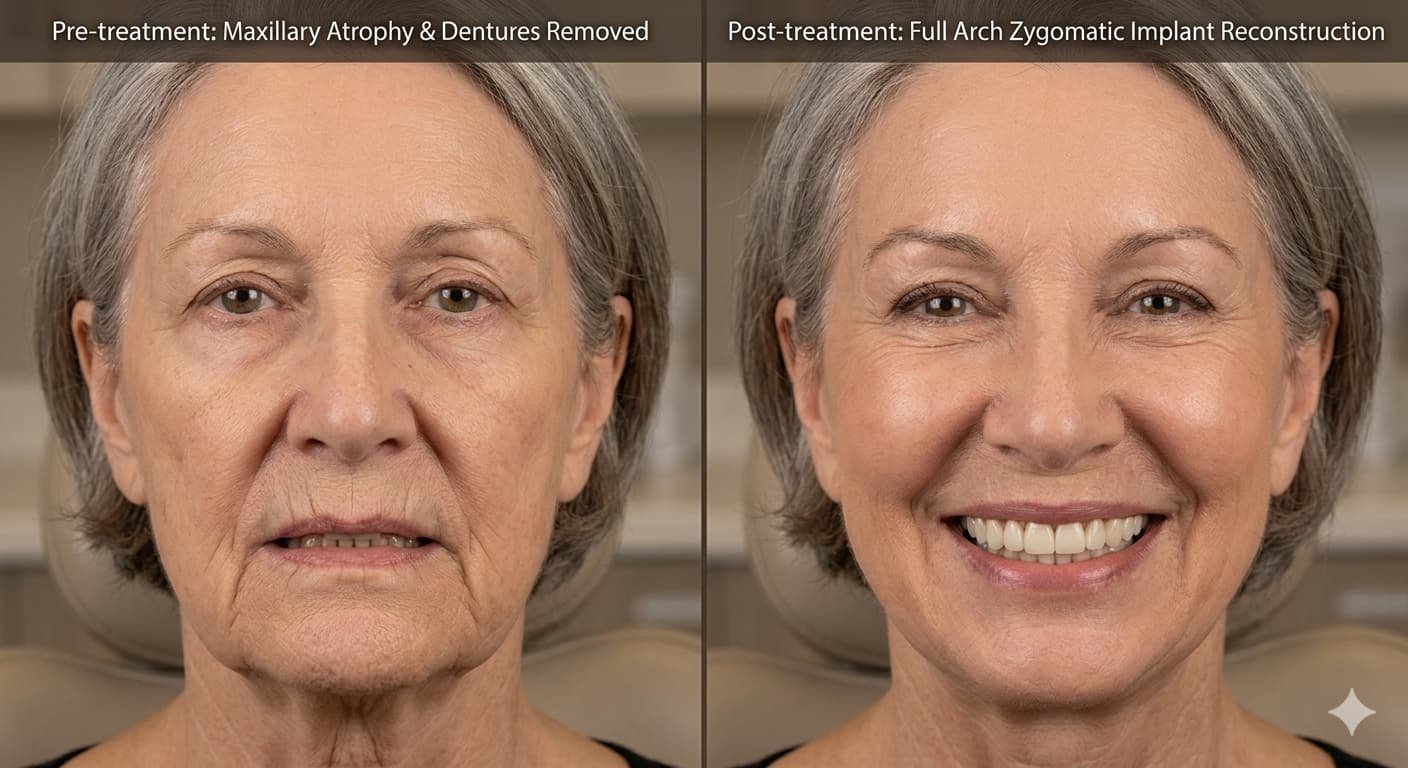
"We told you implants were impossible."
Patients referred for zygomatic implants have almost always been refused conventional implants elsewhere — due to severe bone resorption after years of wearing dentures, failed previous implant attempts, or significant bone destruction from periodontal disease. Zygomatic implants exist specifically for these cases. For the vast majority of patients who arrive with this history, a fixed solution is still achievable.
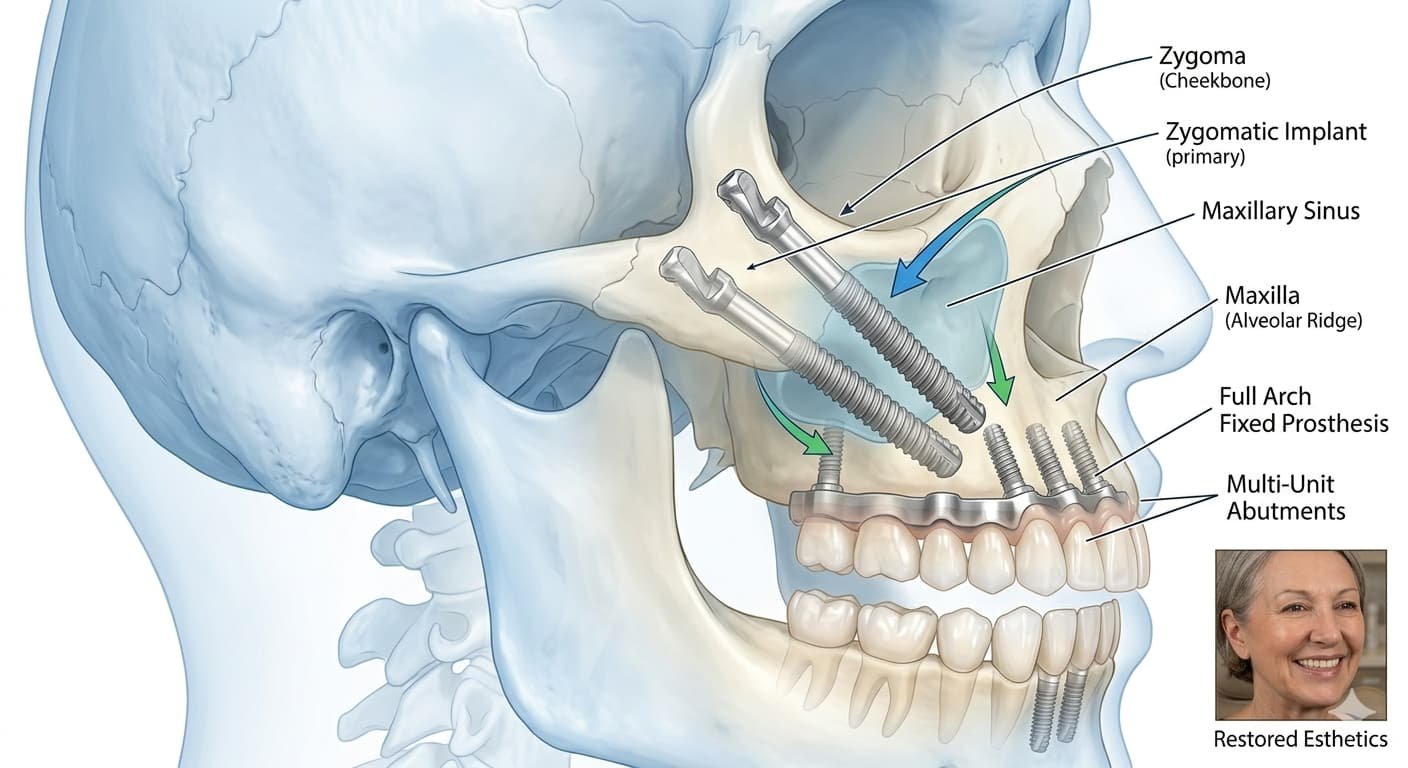
What are zygomatic implants?
Zygomatic implants are extra-long titanium implants — typically 30 to 52.5 mm — that bypass the severely resorbed upper jaw entirely and anchor directly into the zygomatic bone (cheekbone). The zygoma is a dense, highly cortical bone that remains intact even when the maxillary alveolar bone has been almost completely lost. By anchoring here, zygomatic implants provide the stability needed to support a full fixed arch without any requirement for bone grafting or sinus lifting.
The technique was developed by Professor Per-Ingvar Brånemark — the father of modern implantology — for patients who had been excluded from conventional implant treatment. Today it is an established, well-documented procedure with over 20 years of clinical evidence supporting its long-term outcomes.
- Anchored in the cheekbone — not the jawbone
- No bone grafting required in most cases
- No sinus lift procedure required
- Fixed teeth possible the same day in most cases
- 20+ years of peer-reviewed clinical evidence
- Nobel Biocare Zygoma system — the original & most validated
Three things that make zygomatic implants different
Zygomatic implants follow the same fundamental principle as conventional implants — titanium fusing with bone — but differ in three critical ways that make them viable where standard implants are not.
Anchor Point — Cheekbone, Not Jaw
The zygomatic bone is dense cortical bone that is not affected by the alveolar resorption that follows tooth loss. Even patients who have worn dentures for 20 years retain a fully intact zygoma. The implant passes through the maxillary sinus and anchors in this stable structure — providing the fixation that the atrophied jaw can no longer offer.
Length — 30 to 52.5 mm
A conventional dental implant is typically 8 to 14 mm long. A zygomatic implant is 3 to 5 times longer — passing from the alveolar ridge, through or lateral to the maxillary sinus, and into the cheekbone. This length is what provides the multi-cortical anchoring that generates the stability needed for immediate loading.
Configuration — 2 to 4 Implants
Depending on the degree of bone loss, 2 or 4 zygomatic implants may be used per arch — sometimes combined with 2 conventional implants in the anterior region where bone is better preserved. Your CBCT scan determines the optimal configuration for your specific anatomy.
Zygomatic implants vs conventional alternatives
For patients with severe upper jaw bone loss, the realistic alternatives are limited. Here is how zygomatic implants compare to the other options available.
| Factor | Zygomatic Implants | Bone Graft + Conventional | Full Denture |
|---|---|---|---|
| Suitable for severe bone loss | Yes — specifically designed for it | Only after successful grafting | Yes |
| Bone grafting required | No — in most cases | Yes — extensive | No |
| Total treatment time | 4–6 months | 12–24 months | 2–4 weeks |
| Fixed vs removable | Fixed — permanent | Fixed (if successful) | Removable |
| Same-day teeth | Yes — in most cases | No — graft must heal first | Yes |
| Surgical complexity | Advanced — specialist required | Multiple stages | None |
| Chewing function restored | ~95% of natural | ~95% (if successful) | ~25% of natural |
Who is zygomatic implants right for?
Zygomatic implants are an advanced, specialist procedure indicated for a specific group of patients. A full CBCT scan is essential to confirm suitability and plan the exact implant configuration.
Zygomatic implants are indicated if you have…
- Severe upper jaw bone loss — insufficient for conventional implants
- Been told implants are impossible without major bone grafting
- Failed previous conventional implants due to bone resorption
- Worn upper dentures for many years with significant bone collapse
- Significant bone loss from periodontal disease or trauma
- Good general health — no uncontrolled systemic conditions
- An intact zygomatic bone (virtually always the case)
Consider these alternatives first…
- Moderate bone loss — bone grafting + conventional implants may be sufficient
- Insufficient posterior bone only — sinus lift + conventional implants possible
- Lower jaw only — zygomatic implants are for the upper jaw; All-on-4 or All-on-6 for the lower
- Active smoking — very high risk for zygomatic implant failure; cessation is mandatory
- Uncontrolled diabetes or immunosuppression — must be stabilised first
The zygomatic implant procedure — from assessment to fixed teeth
Zygomatic implant treatment follows the same two-visit structure as conventional full-arch implants — with the key difference that no bone graft stage is required between visits.
Online Assessment & X-Ray Review
Send us your existing panoramic X-ray or CBCT scan. We review the degree of bone resorption, confirm that zygomatic implants are the appropriate solution, and provide a written outline of the treatment plan and cost range within 24 to 48 hours. If you do not have recent imaging, we take a full CBCT scan on arrival — this is essential for zygomatic implant planning and is included in the treatment fee.
CBCT Scan & Surgical Planning
A full cone beam CT scan maps the zygomatic bone anatomy, sinus volume, and any residual alveolar bone in three dimensions. This data determines the precise number of implants needed (2 or 4 zygomatic, with or without anterior conventional implants), their exact trajectory through the maxillary sinus, and the entry and exit points at the zygoma. Digital planning software is used to simulate the surgery before it begins.
Zygomatic Implant Surgery
Surgery is performed under local anaesthesia with IV sedation available for anxious patients. Each zygomatic implant is placed through a precise surgical approach — passing through the maxillary sinus and anchoring into the dense zygomatic bone. The procedure typically takes 3 to 5 hours for a full upper arch reconstruction. Post-operative pain and swelling are managed with prescribed medications and typically resolve within 5 to 7 days.
Provisional Fixed Teeth
In most cases, primary stability of the zygomatic implants is sufficient to allow a provisional prosthesis to be attached the same day. You leave the clinic with a fixed set of provisional teeth — no removable denture during the healing period. Where same-day loading is not achievable, a temporary removable solution is provided until the implants have integrated sufficiently for provisional loading.
Osseointegration & Remote Follow-Up
The zygomatic implants integrate with the cheekbone over 3 to 6 months. Because the zygoma is dense cortical bone, integration is typically reliable even in patients with severely compromised general bone quality. You live with the provisional teeth during this period, adhering to a soft-food diet for the first 6 to 8 weeks. Remote follow-up via WhatsApp keeps our team informed throughout.
Final Prosthesis & Completion
Integration is confirmed clinically and radiographically. The provisional prosthesis is removed and the definitive fixed prosthesis — fabricated in our in-house laboratory — is fitted, adjusted, and permanently secured. Occlusion, function, and aesthetics are confirmed. Your 5-year implant guarantee documentation is issued at this appointment.
Zygomatic Implant Cost in Albania
Zygomatic implant cases are priced individually — the number of implants, the configuration (2 or 4 zygomatic + anterior conventional), and the prosthesis material all vary case to case. Below are reference ranges. Your personalised written quote is provided after your CBCT scan is reviewed.
| Treatment | Kocaqi — Tirana | Western Europe avg. | Saving |
|---|---|---|---|
| Zygomatic implants — upper arch (2 zygomatic + 2 conventional) | Get a quote | €18,000 – €28,000 | ~65% |
| Zygomatic implants — upper arch (4 zygomatic) | Get a quote | €22,000 – €36,000 | ~65% |
| Full mouth — Zygomatic upper + All-on-4 lower | Get a quote | €30,000 – €50,000 | ~65% |
| Full mouth — Zygomatic upper + All-on-6 lower | Get a quote | €38,000 – €60,000 | ~65% |
Zygomatic implant pricing is determined by your specific CBCT anatomy — particularly the number of implants needed and the prosthesis configuration. Send us your X-rays for a personalised assessment and indicative quote. All costs are confirmed in writing before any treatment begins.
Why patients choose Kocaqi for zygomatic implants
In-House CBCT — Essential for Zygomatic Planning
Zygomatic implant placement cannot be planned from a 2D panoramic X-ray. The precise trajectory through the maxillary sinus and into the zygoma requires 3D imaging. Our in-house CBCT scanner provides the full anatomical data needed — taken at your first appointment.
Nobel Biocare Zygoma System
We use the Nobel Biocare Zygoma implant system — the original zygomatic implant, developed by the inventor of the technique, with over 20 years of peer-reviewed clinical data behind it. No generic alternatives, no unvalidated systems.
Honest Case Assessment
Zygomatic implants are not the right solution for every patient with bone loss. If conventional implants, bone grafting, or sinus lifting can achieve a good result, we recommend those first. We only propose zygomatic implants where they are genuinely the most appropriate solution.
Fixed Teeth Same Day — Most Cases
The primary stability of Nobel Biocare Zygoma implants in dense cheekbone typically allows provisional fixed teeth to be loaded the same day as surgery. You leave the clinic with functioning teeth and do not need to manage a removable denture during the healing period.
In-House Laboratory
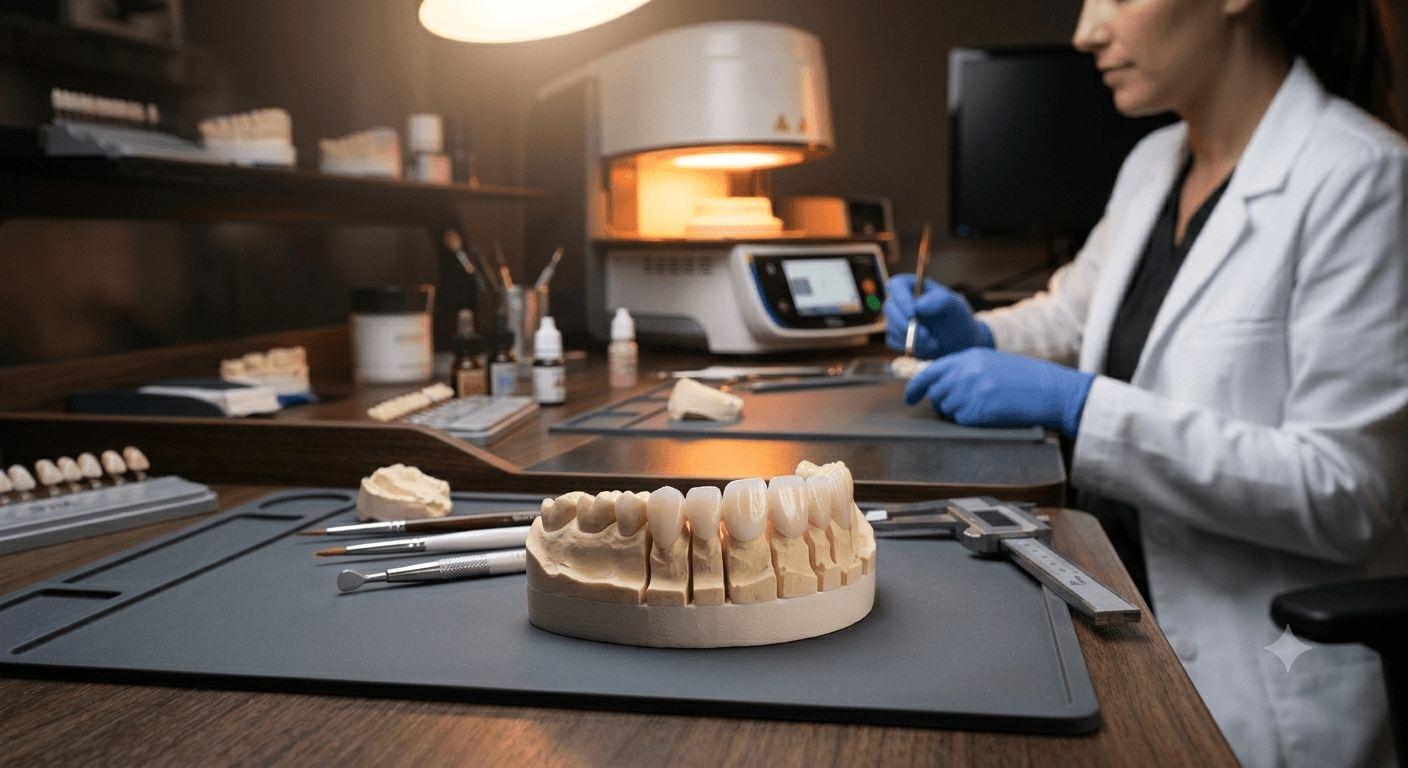
The provisional and final prosthesis for zygomatic cases are both fabricated on-site. The design of the zygomatic prosthesis — particularly the emergence profile and occlusal scheme — requires close collaboration between surgeon and technician, which our in-house setup enables directly.
5-year Written Guarantee
All zygomatic implants placed at Kocaqi Dental carry the same 5-year written guarantee as conventional implants — covering fixture failure and material defects. Documented in your patient record and valid internationally.
Zygomatic implants — your questions answered
What is the difference between zygomatic and conventional implants?
A conventional dental implant is 8 to 14 mm long and anchors in the jawbone (alveolar bone). A zygomatic implant is 30 to 52.5 mm long and anchors in the cheekbone (zygoma), passing through or around the maxillary sinus. Zygomatic implants are used when the upper jawbone has resorbed to the point where conventional implants cannot achieve adequate fixation — they are not a replacement for conventional implants in patients with adequate bone.
Is zygomatic implant surgery painful?
The surgery is performed under local anaesthesia with optional IV sedation for anxious patients. During the procedure you will feel pressure but no sharp pain. Post-surgical discomfort — facial soreness, swelling around the cheek area, and sometimes bruising — is more pronounced than after conventional implant surgery and typically takes 5 to 10 days to resolve. Prescribed pain relief and anti-inflammatories manage this effectively for the vast majority of patients.
Can I have zygomatic implants if I've had previous failed implants?
In most cases, yes. Previous implant failure — particularly due to bone loss — does not preclude zygomatic treatment, because the zygomatic implants anchor in the cheekbone rather than the compromised jawbone. A CBCT scan confirms whether the zygomatic bone is intact (it almost always is) and whether zygomatic implants are feasible. A history of failed conventional implants is in fact one of the most common presentations in zygomatic implant candidates.
Will I need a bone graft before zygomatic implants?
In most cases, no — this is precisely the advantage of zygomatic implants. By anchoring in the cheekbone, they bypass the need for extensive bone reconstruction of the upper jaw. In some cases, 1 to 2 conventional implants may be placed in the anterior region where residual bone is better preserved, but this does not require a preliminary graft stage. The elimination of bone grafting reduces both treatment time and total cost significantly compared to the conventional alternative.
How long do zygomatic implants last?
Published long-term data on Nobel Biocare Zygoma implants — now spanning over 20 years — reports survival rates of 95%+ at 10 years, comparable to conventional implants in normal bone. The prosthesis placed on top typically requires refurbishment after 10 to 15 years. All zygomatic implants placed at Kocaqi Dental carry a 5-year written guarantee.
Is this treatment available for the lower jaw?
No — zygomatic implants are exclusively for the upper jaw, anchoring in the upper cheekbone. The lower jaw does not have equivalent anatomy. For patients requiring full-mouth reconstruction — zygomatic implants in the upper jaw and a full arch solution in the lower — we typically combine zygomatic treatment with All-on-4 or All-on-6 in the lower arch, all coordinated in the same visit.
How do I know if I need zygomatic implants or if conventional implants are still possible?
Only a CBCT cone beam CT scan can answer this definitively. As a general guide: if you have been told by at least one implant dentist that you cannot have conventional implants without major bone grafting, or if you have worn upper dentures for more than 5 to 10 years with significant bone collapse, zygomatic implants are likely to be relevant to your case. Send us your existing X-rays for a preliminary assessment — we will review them and give you an honest evaluation of which solution is most appropriate for your anatomy.
Let us give you a second opinion.
Send us your panoramic X-ray or CBCT scan. We will review your bone anatomy, confirm whether zygomatic implants are appropriate, and provide a personalised written assessment within 24 to 48 hours — free, with no obligation to proceed.
Nobel Biocare Zygoma system · No bone graft required · Fixed teeth same day · 5-year guarantee · 65% saving